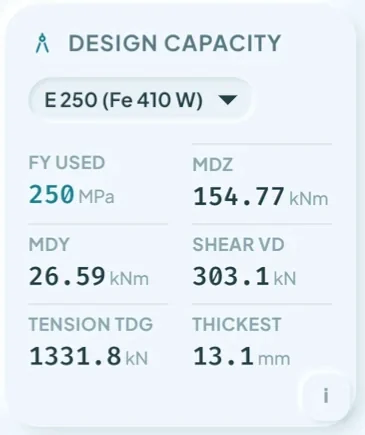
For a rolled I-beam the design capacities come from three short formulas, each using the yield strength fy divided by the material safety factor γm0 = 1.10. Bending: Md = Zp × fy / γm0. Shear: Vd = Av × fy / (√3 × γm0). Tension: Tdg = A × fy / γm0. For MB 300 in E250 steel (fy = 250 MPa) these give 154.77 kNm, 303.1 kN and 1331.8 kN.
What a design capacity is
IS 800:2007 uses limit state design. You work out the force a member must carry using factored loads, and you work out the force it can resist using a design strength. The member passes when the first is no larger than the second.
The design strength is the material strength divided by a partial safety factor. For yielding of structural steel that factor, γm0, is 1.10. So a steel with a yield strength of 250 MPa is treated as having a design yield of 250 ÷ 1.10 = 227.3 MPa.
The yield strength depends on the grade and the thickness. E250 (Fe 410 W) steel to IS 2062 has fy = 250 MPa up to 20 mm thickness, and the value steps down for thicker material. The thickest part of MB 300 is 13.1 mm, so 250 MPa applies.
The numbers you take from the section table
Everything below comes from one row of IS 808:2021, the MB 300 beam. If you want to know what each symbol means, the guide to reading a section table covers them.
| Symbol | Meaning | Value |
|---|---|---|
| Zpz | Plastic section modulus, major axis | 681 cm³ |
| Zpy | Plastic section modulus, minor axis | 117 cm³ |
| Zez | Elastic section modulus, major axis | 599 cm³ |
| A | Cross-section area | 58.6 cm² |
| D | Depth | 300 mm |
| tw | Web thickness | 7.7 mm |
| Izz | Moment of inertia, major axis | 8990 cm⁴ |
Keep the units straight. 1 cm³ is 1000 mm³, so Zpz is 681,000 mm³. Forces below come out in newtons and are converted to kN and kNm.
Bending capacity
For a section that can reach its full plastic moment and is fully restrained against lateral movement of the compression flange, the design bending strength is:
Md = βb × Zp × fy / γm0βb is 1.0 for plastic and compact sections. For bending about the major axis of MB 300:
Mdz = 681,000 × 250 / 1.10 = 154.77 × 10⁶ N·mm = 154.77 kNmAbout the minor axis, the same formula with Zpy gives:
Mdy = 117,000 × 250 / 1.10 = 26.59 kNmFor a simply supported beam the code also limits the moment capacity to 1.2 × Ze × fy / γm0, which protects against permanent deformation at working load. Here that limit is 1.2 × 599,000 × 250 / 1.10 = 163.4 kNm. It is above 154.77 kNm, so the plastic value governs.
The 154.77 kNm figure is an upper bound. It assumes the compression flange cannot buckle sideways. If the beam has a long unrestrained length, lateral torsional buckling reduces the capacity, sometimes by a large amount.
Shear capacity
The web carries the shear. For a rolled I-section bent about its major axis, the shear area is the overall depth times the web thickness. The design shear strength is:
Vd = Av × fy / (√3 × γm0)For MB 300, Av = 300 × 7.7 = 2310 mm². Then:
Vd = 2310 × 250 / (1.732 × 1.10) = 303,100 N = 303.1 kNIf the shear force at a section is more than 60 percent of Vd, the code requires the moment capacity at that section to be reduced. In most simply supported beams the largest shear is at the supports, where the moment is small, so this rarely bites. It matters for short, heavily loaded spans.
Tension capacity
For a member in direct tension, the yielding limit of the gross section is:
Tdg = A × fy / γm0 = 5860 × 250 / 1.10 = 1,331,800 N = 1331.8 kNThis is the yielding check only. In a real tension member with bolt holes, rupture of the net section and block shear at the connection often govern, and they give smaller values. Always check them when the member is connected by bolts. The guide to bolt capacity covers the bolt side of that connection.
Deflection, which is a separate check
Capacity is about strength. Deflection is about serviceability, and it uses the moment of inertia, not the section modulus. For a simply supported beam under a uniform service load w over a span L:
δ = 5 × w × L⁴ / (384 × E × I)E for structural steel is 2 × 10⁵ N/mm². Take an illustrative case: MB 300 over a 6 m span carrying 15 kN/m of service load. With w = 15 N/mm, L = 6000 mm and I = 8.99 × 10⁷ mm⁴:
δ = 5 × 15 × 6000⁴ / (384 × 200,000 × 8.99 × 10⁷) = 14.1 mmThat is span / 426. The limit you compare against depends on the member and what it supports. IS 800 sets the values in its serviceability table, and many floor beams are held to somewhere around span / 300 to span / 360. Look up the limit that applies to your case.
Results in one table
| Check | Formula | Result |
|---|---|---|
| Bending, major axis | Zpz × fy / γm0 | 154.77 kNm |
| Bending, minor axis | Zpy × fy / γm0 | 26.59 kNm |
| Shear | (D × tw) × fy / (√3 × γm0) | 303.1 kN |
| Tension, gross section | A × fy / γm0 | 1331.8 kN |
| Deflection, 6 m span, 15 kN/m | 5wL⁴ / (384EI) | 14.1 mm |
What these three numbers do not cover
A section capacity table is a starting point, not a finished design. These checks still need doing for a real beam:
- Lateral torsional buckling when the compression flange is not fully restrained.
- Section classification, to confirm the section is plastic or compact for the stresses it carries.
- Web buckling and web crippling at supports and under point loads.
- Combined bending and shear, and bending with axial load for columns.
- Connections, including bolts, welds and the net section of the member.
- Load combinations and the partial safety factors on loads.
Check it on your phone
Steel Table India does these capacity calculations for every section in the catalogue. Open any section, and the Design Capacity card in the Inspect panel lists Fy used, Mdz, Mdy, Vd and Tdg. For MB 300 in E250 (Fe 410 W) the card shows 154.77 kNm, 26.59 kNm, 303.1 kN and 1331.8 kN, the same values worked out above. You can change the steel grade from a dropdown.
The Design Calculator goes one step further. Choose a column or a beam, enter the member and the loads, and it returns capacity, deflection and interaction ratios with pass or fail and the numbers shown, so you can see how close the member is to its limit. If a member fails, the Section Optimizer ranks lighter or stiffer alternatives, which the guide to picking the lightest section explains.
Questions people ask
What is γm0 in IS 800?
It is the partial safety factor for the material when checking yielding. IS 800:2007 gives it as 1.10 for structural steel. The yield strength is divided by it to get the design strength.
How do I calculate the bending capacity of an ISMB beam?
Multiply the plastic section modulus Zp by the yield strength fy and divide by γm0 = 1.10. For MB 300, 681,000 mm³ × 250 MPa ÷ 1.10 gives 154.77 kNm, assuming a plastic section that is fully restrained against lateral buckling.
How do I calculate the shear capacity of a steel beam?
Take the shear area as depth times web thickness, then apply Vd = Av × fy / (√3 × γm0). For MB 300 this is 2310 mm² and 303.1 kN.
What yield strength should I use for E250 steel?
E250 steel to IS 2062 has a yield strength of 250 MPa up to 20 mm thickness. It is lower for thicker plates and sections, so check the thickness of the part.
Why is my hand calculation different from the app?
The usual causes are a different steel grade or thickness, a different assumption about lateral restraint or section class, or reduction for high shear. Confirm that both calculations make the same assumptions.
Can I use these results as a complete beam design?
No. They are section capacities. A complete design also needs lateral torsional buckling, web checks, connections and load combinations, and it should be checked by a qualified engineer.
Keep reading
IS 800 capacities, one tap
Steel Table India shows design capacity for every IS 808:2021 section. Free on Google Play, works offline.

For reference, not for sign-off. Section and bolt values quoted here are as shown in Steel Table India, transcribed from the published IS 808:2021 tables and worked to IS 800:2007 methods. Transcription can contain errors, and these worked examples make simplifying assumptions stated in the text. Check critical values against the official Bureau of Indian Standards publications and have designs checked by a qualified engineer. IS 808 and IS 800 are published by the Bureau of Indian Standards.