In ISMB 300, IS means Indian Standard, MB means medium weight beam, and 300 is the nominal depth in millimetres. Each row of the table then lists the dimensions (D, B, tf, tw, R1, R2), the area A and mass per metre, and the section properties about both axes: moment of inertia I, radius of gyration r, and elastic and plastic section moduli Ze and Zp.
Reading a designation like ISMB 300
A designation is a short code with three parts, and you can read it left to right.
- IS is Indian Standard.
- MB is the family, here medium weight beam.
- 300 is the nominal depth in millimetres.
A channel works the same way. ISMC 150 is a medium weight channel, 150 mm deep. Angles are different because they have two legs and a thickness. An angle written ISA 75 75 has two legs of 75 mm each, and the thickness, such as 6 or 8 mm, is listed as a separate number.
Nominal depth is the label, not a promise about every dimension. Always read the actual depth D from the table row.
The section families in IS 808
The letters tell you how heavy and how wide a section is for its depth. Within one nominal depth, the light beam is the lightest, the medium beam sits in the middle, and the wide flange and heavy beams carry more steel.
| Code | Stands for | Worth knowing |
|---|---|---|
| ISMB | Medium weight beam | The everyday rolled beam for floors and roofs |
| ISLB | Light weight beam | Less mass than ISMB at the same depth |
| ISWB | Wide flange beam | Wider flanges, so more stiffness about the minor axis |
| ISHB | Heavy weight beam | Stocky sections, often used as columns |
| ISJB | Junior beam | Small, light beams |
| ISNPB, ISWPB | Narrow and wide parallel flange beam | Flanges with parallel faces, no taper |
| ISMC, ISLC, ISJC | Medium, light and junior channel | C-shaped sections for purlins, bracing and frames |
| ISMPC | Medium weight parallel flange channel | Channel with parallel flange faces |
| ISA | Angle, equal or unequal legs | Bracing, trusses and small frames |
| IS 4923, IS 1161 | Hollow tubes and round pipes | Square and rectangular tubes, and circular pipes |
One real row: MB 300, symbol by symbol
The figure shows where the dimension symbols sit on an I-section. It is a schematic and not drawn to scale.
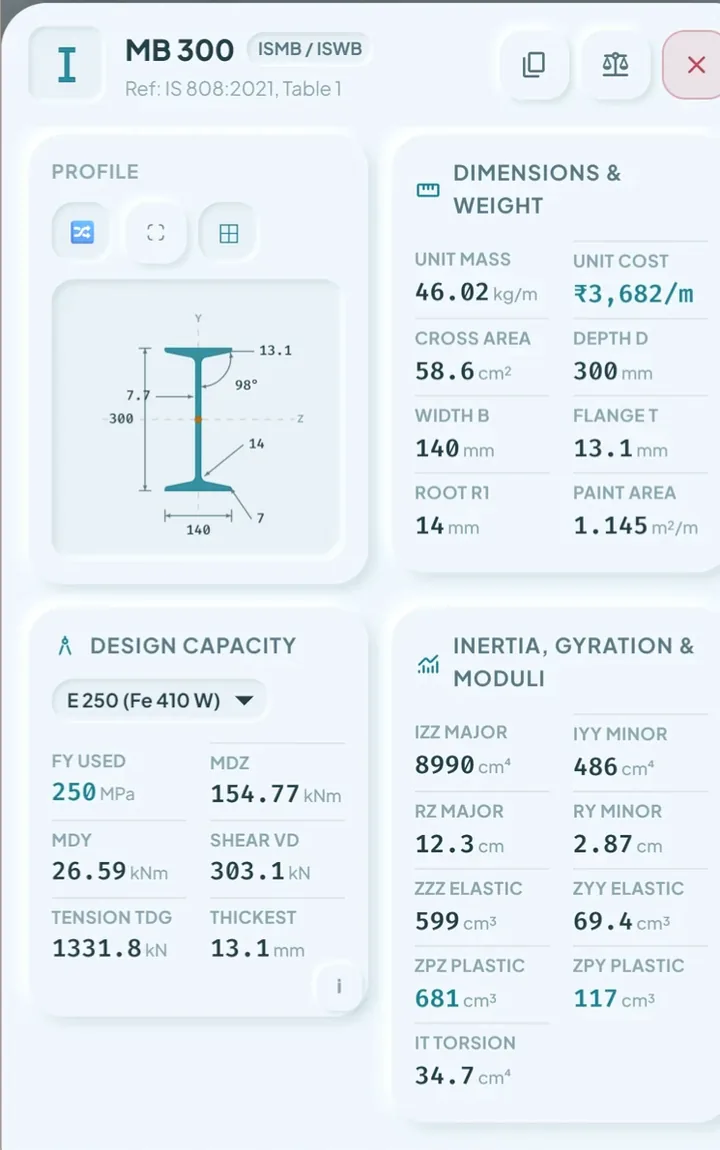
Now a real row. These are the values for MB 300 (the ISMB 300 beam) as Steel Table India shows them from IS 808:2021, Table 1.
| Symbol | Name | What it tells you | MB 300 |
|---|---|---|---|
| D | Depth | Overall height of the section | 300 mm |
| B | Flange width | Width of the top and bottom flange | 140 mm |
| tf | Flange thickness | Thickness of the flange | 13.1 mm |
| tw | Web thickness | Thickness of the web | 7.7 mm |
| R1 | Root radius | Rounded corner where web meets flange | 14 mm |
| R2 | Toe radius | Rounded corner at the flange tip | 7 mm |
| A | Cross-section area | Steel area, used for axial capacity and mass | 58.6 cm² |
| m | Mass per metre | Weight of one metre, used for cost and dead load | 46.02 kg/m |
| Izz | Moment of inertia, major axis | Stiffness against bending about z-z. Drives deflection | 8990 cm⁴ |
| Iyy | Moment of inertia, minor axis | Stiffness against bending about y-y | 486 cm⁴ |
| rz | Radius of gyration, major | Slenderness about z-z, equal to √(Izz / A) | 12.3 cm |
| ry | Radius of gyration, minor | Slenderness about y-y. Often governs column buckling | 2.87 cm |
| Zez | Elastic section modulus, major | Izz divided by the distance to the extreme fibre | 599 cm³ |
| Zey | Elastic section modulus, minor | Same, about y-y | 69.4 cm³ |
| Zpz | Plastic section modulus, major | Bending resistance when the section has fully yielded | 681 cm³ |
| Zpy | Plastic section modulus, minor | Same, about y-y | 117 cm³ |
| It | Torsion constant | Resistance to twisting | 34.7 cm⁴ |
| Paint area | Surface per metre | For paint or galvanising quantities | 1.145 m²/m |
The inner faces of the flanges on a rolled beam are not square to the web. They slope at 98 degrees, which is why the flange is thicker near the web than at the tip. A sketch drawn with plain rectangles misses this, and so does a hand calculation of area.
You can check the table against itself, which is a good habit:
- Elastic modulus: Zez = Izz ÷ (D / 2) = 8990 ÷ 15 = 599 cm³. It matches.
- Shape factor: Zpz ÷ Zez = 681 ÷ 599 = 1.14. For rolled I-sections it is typically a little above 1.1.
- Radius of gyration: √(8990 ÷ 58.6) is about 12.4 cm, close to the 12.3 cm listed. The small gap comes from rounding in the published values.
- Mass: 58.6 cm² × 0.785 = 46.0 kg/m, against 46.02 kg/m listed.
Strong axis, weak axis
Look at Izz and Iyy side by side. 8990 against 486. The beam is about 18.5 times stiffer when bent about its major axis than about its minor axis. That is the whole point of an I-section: put the steel far from the neutral axis in the direction the load acts.
It also explains two habits. A beam must be kept from falling over sideways, because it is weak that way. A column is checked about its smaller radius of gyration, here ry = 2.87 cm, because that is the direction in which it buckles first.
On naming: IS 800:2007 calls the major axis z-z and the minor axis y-y. Older handbooks call them x-x and y-y. They are the same axes.
Depth matters a lot. Take MB 150 from the same table: depth 150 mm, area 19 cm², mass 14.96 kg/m, Izz 718 cm⁴. Doubling the depth to MB 300 takes the mass from 14.96 to 46.02 kg/m, about 3 times, but Izz goes from 718 to 8990 cm⁴, about 12.5 times. Deeper sections buy stiffness cheaply.
Which number to use for which check
| You want to know | Look at |
|---|---|
| Deflection of a beam | Izz, the major axis moment of inertia |
| Bending capacity | Zpz or Zez, depending on the section class and the code check |
| Column buckling | A and the smaller radius of gyration, usually ry |
| Weight, dead load and cost | Mass per metre |
| Connection detailing | B, tf, tw and R1, which decide where bolts and welds can go |
| Paint or galvanising quantity | Paint area per metre |
| Lightest section for a target stiffness | Izz against mass, which is what an optimizer ranks |
The code check itself, with its partial safety factors and clauses, is IS 800. The table gives you the inputs. If you want the weight and cost side of the same row, the guide to steel weight and cost covers it.
Slips that cost people time
- Reading the wrong axis. Using Iyy for beam deflection makes the beam look 18 times worse than it is. Using Izz for column buckling makes the column look far too good.
- Units. Moment of inertia is in cm⁴ in the table. Many calculations run in mm⁴, and 1 cm⁴ is 10,000 mm⁴. So 8990 cm⁴ is 8.99 × 10⁷ mm⁴. Radius of gyration is in cm, while dimensions are in mm.
- Mixing editions. Older handbooks list different values for some designations. Use one edition for the whole calculation.
- Treating nominal depth as actual depth. The 300 in ISMB 300 is a label. Use D from the row.
- Mass read as force. The table gives kg per metre. A dead load in kN per metre needs the factor for gravity applied.
See every symbol on your phone
Most people forget R1, R2 and the rest between projects, so the table becomes a page of letters again. Steel Table India shows the dimensioned sketch next to the values, and tapping a symbol turns it into its real number in millimetres.
- Search for a section, for example
MB 300, or browse a family. - Tap it to open the Inspect panel with the sketch, dimensions, mass, cost, inertia, radii and moduli.
- Swipe to the next or previous section without closing the panel.
- Go full screen to see only the sketch with every dimension labelled.
- For flats and round bars, type your own size and every property recalculates.
The animation next to this article walks through the same steps in 36 seconds. The sections come from IS 808:2021 and are stored on the phone, so you can check a value on site with no signal.
Questions people ask
What does ISMB stand for?
Indian Standard Medium weight Beam. The number after it, as in ISMB 300, is the nominal depth in millimetres.
What is the difference between ISMB and ISWB?
For the same nominal depth, an ISWB has wider flanges than an ISMB. It carries more mass and is stiffer about its minor axis.
What do R1 and R2 mean?
R1 is the root radius, the rounded corner where the web meets the flange. R2 is the toe radius, the rounded corner at the flange tip.
What is the difference between elastic and plastic section modulus?
The elastic modulus Ze is the moment of inertia divided by the distance to the extreme fibre. The plastic modulus Zp assumes the whole section has yielded, so it is larger. For rolled I-sections it is typically a little over 1.1 times Ze.
Which moment of inertia do I use for beam deflection?
For a beam bent about its strong axis, use the major axis value, written Izz in IS 808:2021 and Ixx in older tables.
Where can I check IS 808:2021 values without internet?
In Steel Table India. It keeps the sections on your phone with a dimensioned sketch and every property, works without a signal, and is free on Google Play.
Keep reading
Every symbol, one tap
Steel Table India is free on Google Play. IS 808:2021 sections with a dimensioned sketch, offline.

For reference, not for sign-off. Values for MB 300 and MB 150 are as shown in Steel Table India, transcribed from the published IS 808:2021 tables. Transcription can contain errors, so check critical values against the official Bureau of Indian Standards publication before using them in a design, drawing or order. IS 808:2021 and IS 800:2007 are published by the Bureau of Indian Standards.