Steel weighs 7850 kg per cubic metre. For a flat, bar, plate or pipe, work out the mass per metre with the formulas below. For a rolled beam, channel or angle, read the kg per metre from the IS 808 table. Then multiply by length, quantity and your rate per kg. Example: an MB 300 beam is 46.02 kg/m, so a 6 m piece weighs 276.12 kg and costs about ₹22,090 at ₹80 per kg.
The one formula behind every steel weight
Every weight in this guide comes from one fact. A cubic metre of steel weighs 7850 kg. So the weight of any piece is its volume times that number.
Weight (kg) = cross-section area (m²) × length (m) × 7850Square metres are awkward for steel sections, which are measured in millimetres and square centimetres. If you have the area in cm², the mass of one metre is simpler to get:
kg per metre = area in cm² × 0.785Check it against a real section. The MB 300 beam (ISMB 300) in IS 808:2021 has a listed area of 58.6 cm² and a listed mass of 46.02 kg/m. Multiply 58.6 by 0.785 and you get 46.0 kg/m. The small gap is rounding in the published area.
Hand formulas for flats, bars, plates and pipes
Plain shapes have no tapers or radii, so you can calculate them yourself. Put every dimension in millimetres and the formulas below give kg per metre (kg per square metre for plate).
| Shape | Formula | Example |
|---|---|---|
| Flat bar or strip | width × thickness × 0.00785 | 100 × 10 mm = 7.85 kg/m |
| Plate (per m²) | thickness × 7.85 | 10 mm plate = 78.5 kg/m² |
| Round bar | diameter² × 0.006165 | 20 mm = 2.466 kg/m |
| Square bar | side² × 0.00785 | 25 mm = 4.91 kg/m |
| Round pipe or tube | (outside dia - wall) × wall × 0.02466 | 60.3 × 3.6 mm = 5.03 kg/m |
| Square or rectangular hollow section | (2 × (a + b) - 4 × wall) × wall × 0.00785 | 50 × 50 × 3 mm = 4.43 kg/m |
The hollow section formula ignores the rounded corners, so it reads a little high. For a purchase order, use the supplier's table.
For a plate, multiply the kg per square metre by the area. A 10 mm plate that is 1.5 m by 6 m has an area of 9 m², so it weighs 78.5 × 9 = 706.5 kg.
Weight calculator
This uses the same formulas as the table above. Change the numbers and the weight and cost update. Everything runs on your device.
Weight and cost calculator
Flat bar or plate, round bar, square bar, round pipe.
Rebar weight chart
Reinforcement bar is the most searched steel weight of all. The formula is diameter squared times 0.006165, which is the same as diameter squared divided by 162. Bars are usually supplied in 12 m lengths, so the last column gives the weight of one full bar.
| Diameter | kg per metre | kg per 12 m bar | Bars per tonne |
|---|---|---|---|
| 8 mm | 0.395 | 4.74 | 211 |
| 10 mm | 0.617 | 7.40 | 135 |
| 12 mm | 0.888 | 10.65 | 94 |
| 16 mm | 1.578 | 18.94 | 53 |
| 20 mm | 2.466 | 29.59 | 34 |
| 25 mm | 3.853 | 46.24 | 22 |
| 32 mm | 6.313 | 75.76 | 13 |
Bars from a mill can differ slightly from the nominal mass. If you buy by weight, expect the weighbridge figure to be a little off the chart and allow for that in the quotation.
Beams, channels and angles: read the table
Do not draw an I-beam and calculate it. Rolled sections have tapered flanges and rounded corners at the root and toe, and a simple drawing misses them. The mass per metre in IS 808 is worked out from the full profile, so take it straight from the table.
One warning about editions. Older handbooks list different masses for some designations than IS 808:2021 does. If a quotation or a drawing uses the old value and you use the new one, your totals will not match. Check which edition each number comes from.
The cost per metre is then a single multiplication:
MB 300: 46.02 kg/m × ₹80 per kg = ₹3,681.60 per metreWorked example: weight and cost of a small frame
Here is a short material list priced at ₹80 per kg. The rate is an example. Use today's rate from your supplier. Weight for each line is kg per metre times length times quantity.
| Member | Qty | Length | kg/m | Weight | Cost |
|---|---|---|---|---|---|
| MB 300 beam | 4 | 6.0 m | 46.02 | 1,104.48 kg | ₹88,358.40 |
| Flat 100 × 10 mm | 12 | 2.0 m | 7.85 | 188.40 kg | ₹15,072.00 |
| 20 mm rebar | 20 | 12.0 m | 2.466 | 591.84 kg | ₹47,347.20 |
| Total | 1,884.72 kg | ₹1,50,777.60 | |||
Quotes are often given per tonne. Divide by 1000 to get the rate per kg, so ₹80,000 per tonne is ₹80 per kg. A single rate for every line is a simplification. In practice a beam, a flat and a rebar bar are priced differently, so use a separate rate for each category.
What an estimate usually leaves out
The weight times rate figure is the price of steel and nothing else. Keep these as separate lines so the steel number stays clean:
- Cutting waste, since you buy full lengths and cut them down.
- Fabrication and labour, welding material and bolts.
- Painting or galvanising.
- Transport and handling to site.
- GST.
- A change in the steel rate between the day you quote and the day you buy.
Mistakes that change the number
- Metres and feet mixed up. One metre is 3.281 feet. To get kg per foot, divide kg per metre by 3.281. A section at 46.02 kg/m is about 14.03 kg per foot.
- Millimetres and centimetres mixed up. The formulas above use mm. The 0.785 shortcut uses cm². Mixing the two gives a result that is off by a factor of 100.
- Per tonne read as per kg. ₹80,000 is a rate per tonne. Typing it as a rate per kg multiplies the cost by 1000.
- Old table, new drawing. Take masses from the same edition of IS 808 on every line of the estimate.
- One rate for everything. Beams, plates, bars and pipes rarely cost the same per kg.
- Theoretical weight read as purchase weight. Rolling tolerance means the delivered weight can differ slightly from the table.
Do it faster in Steel Table India
Everything above is what the app does for you, using the IS 808:2021 tables stored on your phone. It works without a signal.
- Open Steel Mode and search for a section such as
MB 300, or browse a category. - Tap it. The Inspect panel shows unit mass and unit cost, along with the dimensioned sketch, area, moment of inertia and section moduli.
- Set your rate in rupees per kg once, and choose metres or feet. Every cost in the app follows. A category can have its own rate with the ₹ button on its card.
- Enter your members in the quantity estimator to get total weight and total cost on one screen. Change the rate and the whole estimate updates.
- Export a category as CSV for Excel or STAAD when you need the numbers elsewhere.
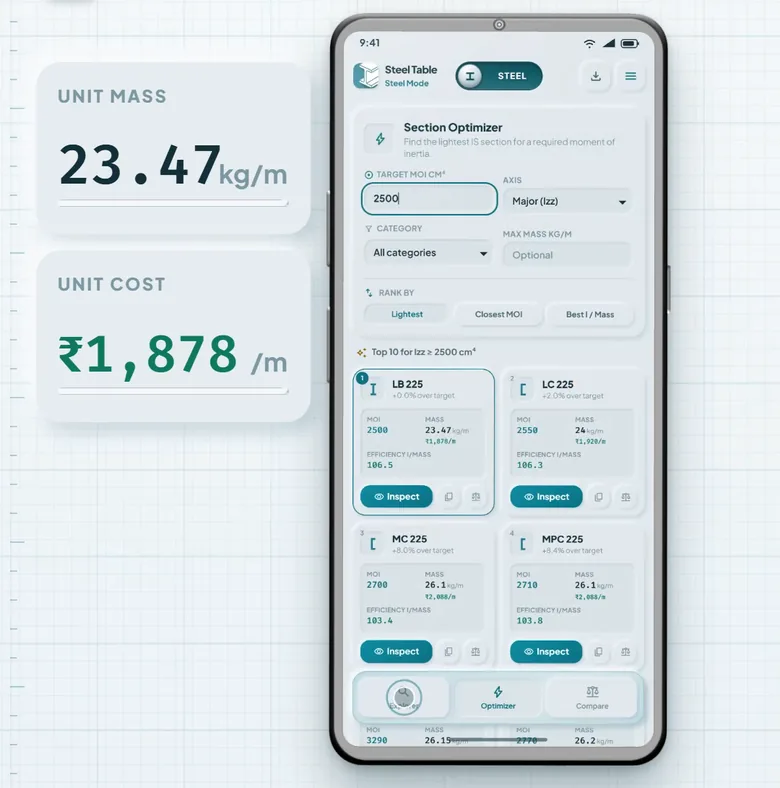
If you are choosing between sections, the Section Optimizer ranks the lightest IS sections that meet a target moment of inertia, with the mass and cost of each beside it. The short animation next to this article shows the same thing in 36 seconds.
Questions people ask
How do I calculate the weight of a steel beam per metre?
For a rolled beam, read the mass in kg per metre from the IS 808 table. If you only have the area in cm², multiply it by 0.785. An area of 58.6 cm² gives about 46 kg/m.
What density of steel should I use?
Use 7850 kg per cubic metre. It is the standard value for structural steel and the basis of every formula on this page.
How much does a 12 mm rebar weigh per metre?
About 0.888 kg per metre. A full 12 m bar weighs about 10.65 kg.
How do I convert kg per metre to kg per foot?
Divide by 3.281. For example, 46.02 kg/m is about 14.03 kg per foot.
Why does my hand calculation differ from the handbook weight?
Rolled sections have tapered flanges and corner radii that a simple drawing leaves out. The handbook value comes from the full profile. Also check that both numbers come from the same edition of IS 808.
Can I get steel weight and cost on my phone without internet?
Yes. Steel Table India keeps the IS 808:2021 data on the phone, shows unit mass and unit cost at your own rate, and works without a signal. It is free on Google Play, with no account to create.
Keep reading
Price a section in seconds
Steel Table India is free on Google Play. IS 808:2021 sections, your own rate, no signal needed.

For reference, not for sign-off. Section values quoted here are as shown in Steel Table India, transcribed from the published IS 808:2021 tables, and the rates are examples. Check critical values against the official Bureau of Indian Standards publication and your supplier before using them in a design, drawing or order. IS 808:2021 is published by the Bureau of Indian Standards.