A phone can act as a torch with a slow SOS strobe, a compass, a coordinates readout you can copy and read aloud, a level, a loud siren and a bright screen, all without a signal. SOS in Morse is three short flashes, three long, three short. Tell someone your route, carry a power bank, and remember that no app replaces preparation. Here & Home includes these tools offline, plus a short survival manual.
What the phone can do offline
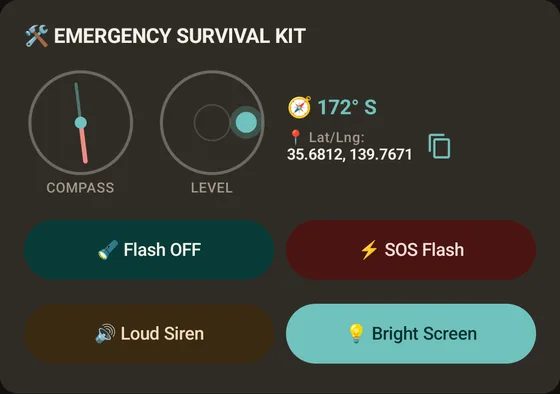
Modern phones carry sensors that do not need a mobile signal. A survival kit screen puts them in one place:
- Flashlight with a steady beam and a strobe.
- SOS flash, a slow strobe in the international distress pattern.
- Loud siren to attract attention.
- Bright screen, a white screen you can wave or use as a light.
- Compass and your latitude and longitude, ready to copy.
- Level, to show how your phone is tilted.
Signalling: SOS and the rule of three
The international distress signal in Morse code is SOS: three short signals, three long, three short. It works with a light, a whistle or a horn. More generally, three of anything, three whistle blasts, three flashes or three shouts, is recognised as a call for help. Repeat after a pause.
A slow strobe is easier for someone far away to notice than a steady light. Use it when you can see or hear a possible rescuer, not all night, because it drains the battery.
Compass and coordinates
- Calibrate the compass by moving the phone in a figure of eight if the reading looks wrong.
- Keep it away from metal and magnets, including phone cases with magnets, cars and power lines.
- Hold it flat. A tilted phone gives a poor heading.
- Read the coordinates aloud in full if you reach emergency services: the numbers, the letters and the direction of each. The readout can be copied and sent in a message when a signal returns.
A compass tells you a direction, not a route. Use it with a map you have saved offline.
The level
A level shows how your phone is tilted. It is a small tool, but it can help you find a flat place to sleep or sit, and tell which way is up when you are disoriented.
Protect the battery
- Switch on airplane mode when you have no signal, because searching for signal drains the battery fast.
- Lower the screen brightness and close apps you do not need.
- Use the flashlight and siren only when needed, since both use a lot of power.
- Keep the phone warm in cold weather, because the battery loses charge fast when cold.
- Carry a power bank and a short cable.
What matters more than the app
- Tell someone where you are going and when you expect to be back.
- Carry water, layers, a whistle, a paper map and a torch with spare batteries.
- Check the weather and the time of sunset before you start.
- Turn back early if conditions change.
- Stay put if you are lost and someone knows your route. Moving makes you harder to find.
- The survival rule of threes: you can survive about three minutes without air, three hours in harsh weather without shelter, three days without water, and three weeks without food. Shelter and water come before almost everything else.
No app replaces preparation or training. Treat the phone as one useful tool among several.
In Here & Home
The Help section includes the Emergency Survival Kit described above, works without a signal, and has a short offline manual covering fire, water, wildlife, heat and cold. It also holds emergency numbers and phrases for the country. Do not rely on any app alone in a life-threatening emergency, and check official safety advice for where you are going.
Questions people ask
What is the SOS signal with a flashlight?
Three short flashes, three long, three short, repeated after a pause. Three of anything is also recognised as a call for help.
Does a phone compass work without a signal?
Yes. It uses the phone's sensors, not the mobile network. Calibrate it and keep it away from metal and magnets.
How do I find my coordinates with no signal?
The phone's GPS works without mobile signal. Here & Home shows your latitude and longitude, ready to copy and read out.
Will the flashlight drain my battery?
Yes, and the strobe and siren use a lot of power. Use them only when needed and keep a power bank.
What should I do if I am lost?
Stay where you are if someone knows your route, stay warm and dry, and signal with three of anything. Moving makes you harder to find.
Can the app replace a map and training?
No. It is a helpful tool, not a replacement for preparation. Do not rely on any app alone in a life-threatening emergency.
Keep reading
Be ready
Here & Home is free on Google Play. A survival kit that works with no signal.

For reference. Steps and screens described here are as they appear in Here & Home, and menu names can differ between versions of Android and the app. Exchange rates and prices in examples are illustrative, and rates in Here & Home are indicative, updated periodically and not financial quotes. Emergency numbers, phrases, country facts and survival tips are general information given on a best-effort basis: check them before you travel, and do not rely on any app alone in a life-threatening emergency. Here & Home is a field companion, not a financial or emergency service. Trademarks are those of their owners and are used only to describe what the app works with.