Check three things before you pack: the plug type, the voltage and the driving side. Japan uses plug types A and B at 100 V on the left; the UK uses type G at 230 V on the left; the US uses A and B at 120 V on the right. An adapter only changes the plug shape. It does not change voltage, so check that your charger says 100 to 240 V.
Quick table for popular destinations
These are standard values. Local conditions, older buildings and hotels with their own sockets can differ, so treat the table as a starting point.
| Country | Plug types | Voltage | Frequency | Drives on the |
|---|---|---|---|---|
| Japan | A, B | 100 V | 50 and 60 Hz | Left |
| United Kingdom | G | 230 V | 50 Hz | Left |
| United States | A, B | 120 V | 60 Hz | Right |
| France | C, E | 230 V | 50 Hz | Right |
| Germany | C, F | 230 V | 50 Hz | Right |
| Italy | C, F, L | 230 V | 50 Hz | Right |
| Spain | C, F | 230 V | 50 Hz | Right |
| Switzerland | C, J | 230 V | 50 Hz | Right |
| Australia | I | 230 V | 50 Hz | Left |
| India | C, D, M | 230 V | 50 Hz | Left |
| Thailand | A, B, C, F, O | 220 to 230 V | 50 Hz | Left |
| Singapore | G | 230 V | 50 Hz | Left |
| United Arab Emirates | G | 230 V | 50 Hz | Right |
| China | A, C, I | 220 V | 50 Hz | Right |
| Mexico | A, B | 127 V | 60 Hz | Right |
Plug types in plain words
| Type | Looks like | Common in |
|---|---|---|
| A | Two flat parallel pins | US, Canada, Japan, Mexico |
| B | Type A plus a round earth pin | US, Canada, Japan, Mexico |
| C | Two thin round pins (Europlug) | Most of Europe, India, Indonesia |
| D | Three large round pins in a triangle | India |
| E | Two round pins with a hole for an earth pin | France |
| F | Two round pins with earth clips at the sides | Germany, Spain and much of Europe |
| G | Three rectangular pins | UK, Ireland, Singapore, UAE |
| I | Two angled flat pins, sometimes with an earth pin | Australia, China, New Zealand |
| J | Three round pins, Swiss pattern | Switzerland |
| L | Three round pins in a row | Italy |
| M | Three large round pins, bigger than type D | India, South Africa |
| O | Three round pins in a triangle, Thai pattern | Thailand |
Adapter or converter?
- An adapter changes the shape of the plug so it fits the socket. It does not change the voltage.
- A converter or transformer changes the voltage. It is needed for devices that cannot take the local voltage.
- Most phone, tablet and laptop chargers are dual voltage: the label says something like "Input 100 to 240 V, 50/60 Hz". For these, a plain adapter is enough.
- Hair dryers, straighteners and some travel kettles are often single voltage. Plugging a 120 V one into 230 V can destroy it, so check the label.
- A universal adapter with a few USB ports covers most trips.
Driving side
Roughly a third of the world's countries drive on the left, including the UK, Japan, India, Australia, Thailand and Singapore. Most of the rest drive on the right. If you plan to drive, check the local rules for foreign licences, whether you need an international driving permit, and the speed limits, which are often in kilometres per hour or in miles per hour. Take extra care at roundabouts and junctions in your first hours after switching side.
What else to know before landing
- Currency and its notes and coins. See currencies with many zeros.
- Language and a few useful words. See emergency phrases.
- Calling code and the time difference.
- Emergency numbers. See the list by country.
- Etiquette: tipping, greetings, dress, and what to avoid.
- Visas and health rules from official sources.
An offline country guide
The FYI section of Here & Home is a country overview saved on the phone. For each country it lists the capital, language, currency, time zones, calling code, driving side, plugs and voltage, key facts, etiquette notes and top destinations, plus twenty everyday words. For Japan it shows capital Tokyo, language Japanese, driving side left, plugs A and B, and 100 V at 50 and 60 Hz, which matches the table above. It needs no signal.
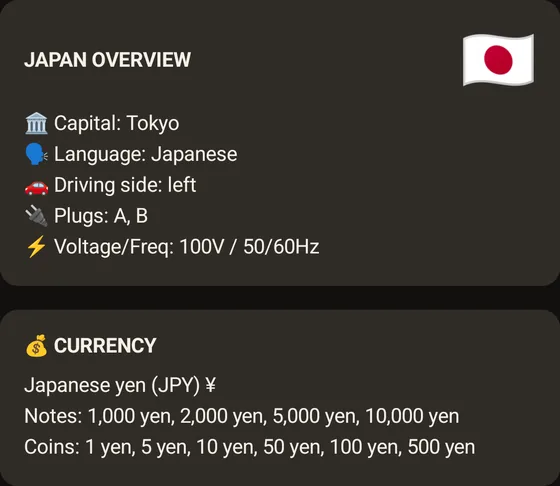
Facts are given on a best-effort basis for offline reference. Check visa, health and safety rules with official sources before you travel.
Questions people ask
What plug do I need in Japan?
Types A and B, the same two-flat-pin plugs as in the US. Japan's voltage is 100 V.
Do I need a voltage converter for my phone charger?
Usually not. Most phone and laptop chargers accept 100 to 240 V, so a plug adapter is enough. Check the label.
What is the difference between an adapter and a converter?
An adapter changes the plug shape. A converter changes the voltage.
Which countries drive on the left?
Among popular destinations, the UK, Japan, India, Australia, Thailand and Singapore drive on the left.
Is the country guide in the app offline?
Yes. FYI is saved on the phone and works with no signal.
How current is the information?
It is given on a best-effort basis. Check official sources before you travel.
Keep reading
Know the country before you land
Here & Home is free on Google Play. A country guide saved offline.

For reference. Steps and screens described here are as they appear in Here & Home, and menu names can differ between versions of Android and the app. Exchange rates and prices in examples are illustrative, and rates in Here & Home are indicative, updated periodically and not financial quotes. Emergency numbers, phrases, country facts and survival tips are general information given on a best-effort basis: check them before you travel, and do not rely on any app alone in a life-threatening emergency. Here & Home is a field companion, not a financial or emergency service. Trademarks are those of their owners and are used only to describe what the app works with.