In currencies such as the yen, won, dong and rupiah, everyday prices run to thousands or tens of thousands and there are no cents in daily use. Group the digits in threes, say the number in thousands, count the zeros twice, and type it with a key that enters three zeros at once. A misplaced zero makes a meal ten times dearer or cheaper.
Why the zeros happen
A currency's face value is a historical accident. Some countries ended up with a small unit, and prices became large numbers. A meal that costs 15 dollars may cost 2,000 yen, 20,000 won, 350,000 dong or 250,000 rupiah. Nothing is wrong with that, but a visitor from a country with small numbers can easily be a factor of ten out, and a factor of ten is the difference between a cheap lunch and a very expensive one.
Currencies with large numbers
These currencies commonly have large prices or no cents in daily use. The ranges below are typical, not exact, and prices vary widely.
| Currency | Code | Everyday cents? | A typical cheap meal looks like |
|---|---|---|---|
| Japanese yen | JPY | No | Hundreds to low thousands |
| Korean won | KRW | No | Thousands to tens of thousands |
| Vietnamese dong | VND | No | Tens to hundreds of thousands |
| Indonesian rupiah | IDR | Not used | Tens of thousands to over a hundred thousand |
| Hungarian forint | HUF | Not used | Thousands |
| Chilean peso | CLP | No | Thousands |
| Icelandic krona | ISK | No | Thousands |
Where there are no everyday cents, a decimal point is not needed, and a stray one on a price tag is easy to misread.
How to read the number
- Group in threes. 50000 is 50,000, fifty thousand. Look at the commas or dots as grouping marks, not decimals.
- Check the separator. Many countries use a dot for thousands and a comma for decimals, the opposite of English. 1.500 may mean one thousand five hundred.
- Say it in thousands. "Fifty thousand" is harder to mis-hear than "five zero zero zero zero".
- Count the zeros twice. It takes two seconds.
- Sense-check. Does the price match the kind of place? A street snack that comes to 50,000 yen is a mistake.
Local counting units
Japanese, Korean and Chinese count in units of ten thousand, not thousand. In Japanese, 10,000 yen is ichi-man (one man). In Korean it is man as well. A price of 3-man 5-sen is 35,000 in Japanese, as in 3 × 10,000 plus 5 × 1,000. Knowing this helps when a shopkeeper says a price aloud. Indian readers will recognise the same problem in reverse: lakh and crore group digits as 1,00,000 and 1,00,00,000, so check which grouping a price follows.
Typing it safely
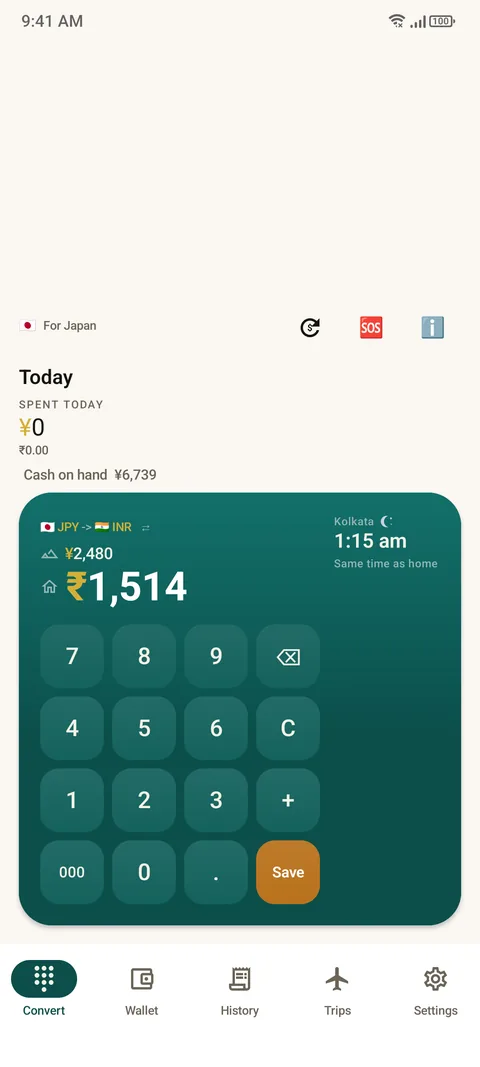
Where mistakes happen is the keypad. Typing 50000 means five key presses and four of them are zeros. Here & Home's converter has a 000 key: ¥65,000 is 6, 5, then 000. Where a currency has no everyday cents, the decimal key becomes a swap key, so you cannot type cents that do not exist. The answer appears big and clear in your home currency.
Paying with confidence
- Read the total on the card machine and check the zeros before you tap.
- If a machine offers to charge you in your home currency, read the guide to card fees and DCC first.
- Keep a basket total with the plus key to avoid a shock at the till.
- Save the expense straight away, so the figure is in your trip and not in your head.
Questions people ask
Which currencies have the most zeros?
Prices in Vietnamese dong and Indonesian rupiah often run to tens or hundreds of thousands. Yen, won, forint and others commonly reach thousands.
Why does the yen have no decimals?
The yen has no everyday minor unit, so prices are whole numbers. The same is true of the won, dong and some other currencies.
How do I avoid being ten times out?
Group the digits in thousands, count the zeros twice, sense-check against the type of place, and use a keypad with a 000 key.
What does ichi-man mean?
In Japanese, ichi-man is 10,000, one ten-thousand. Japanese prices are often counted in units of ten thousand.
Why do some countries use a dot for thousands?
Different countries use different separators. A dot can mean thousands and a comma decimals, the opposite of English.
Does Here & Home handle large numbers?
Yes. The keypad has a 000 key, and where a currency has no everyday cents the decimal key becomes a swap key.
Keep reading
Never count zeros again
Here & Home is free on Google Play. A 000 key for big prices.

For reference. Steps and screens described here are as they appear in Here & Home, and menu names can differ between versions of Android and the app. Exchange rates and prices in examples are illustrative, and rates in Here & Home are indicative, updated periodically and not financial quotes. Emergency numbers, phrases, country facts and survival tips are general information given on a best-effort basis: check them before you travel, and do not rely on any app alone in a life-threatening emergency. Here & Home is a field companion, not a financial or emergency service. Trademarks are those of their owners and are used only to describe what the app works with.