Memorise one anchor: how much a round amount of the foreign currency is in your own, for example 1,000 units. Then scale: 2,480 is about two and a half anchors. Round the price, multiply by the anchor, and treat the result as a guide. Check anything over a small amount with a converter, because a 5 percent error is small on a coffee and large on a hotel.
The anchor method
Most travellers try to remember an exchange rate as a long decimal, such as 0.0061. That is hard to use in your head. A better habit is to remember an anchor: the value of a round amount.
- Pick a round amount of the foreign currency that is typical on a price tag, such as 1,000 or 100.
- Work out what it is in your home currency once, from a converter, and remember that.
- For any price, count how many anchors it is, and multiply.
The anchor is the only number you need to refresh, and you can check it once a day.
Worked examples
These use example rates only. Real rates change daily, so use your own anchor.
| Price | Anchor | In your head | Result |
|---|---|---|---|
| ¥2,480 | ¥1,000 is about ₹610 | 2.5 anchors: 2.5 × 610 | About ₹1,525 |
| ¥450 | ¥1,000 is about ₹610 | Under half an anchor: about 275 | About ₹275 |
| €18 | €1 is about ₹90 | 18 × 90: 20 × 90 = 1,800, less 180 | ₹1,620 |
| £7.50 | £1 is about ₹105 | 7.5 × 10⁵: 7 × 105 = 735, plus 52 | About ₹787 |
| $40 | $1 is about ₹84 | 40 × 84: 4 × 84 = 336, then × 10 | ₹3,360 |
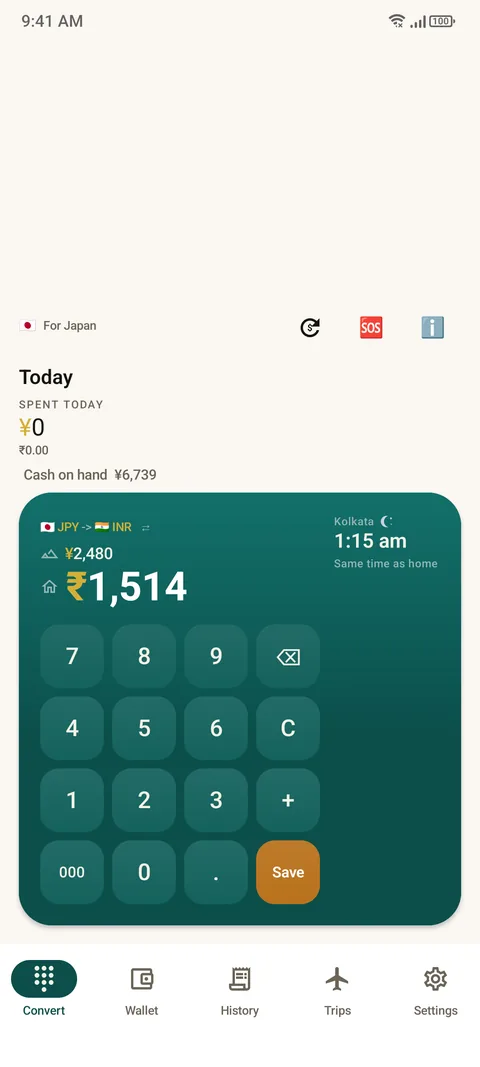
The app's own converter shows ¥2,480 as ₹1,514 at its saved rate, which is within about 1 percent of the quick estimate in the first row.
Rounding rules that keep you honest
- Round the price, not the anchor. Turn 2,480 into 2,500, not 610 into 600.
- Round in the direction that makes you careful. Round the cost up and the budget down.
- Use halves and tens. Double, halve, move the decimal. They are easier than long multiplication.
- Split big prices. 12,900 is 10,000 plus 2,900. Do each part and add.
When there are lots of zeros
The risk in a high-number currency is not the multiplication, it is the zeros. Say the price in thousands and in the local counting unit: 10,000 yen is "ichi-man" in Japanese, one ten-thousand. Write the amount with commas in your head, and count the groups. See currencies with many zeros.
When not to guess
- Large purchases. A 3 percent error on a hotel bill is real money.
- Card payments. The card adds a fee and uses its own rate, so the final amount differs from a quick estimate. See card fees explained.
- Rates that moved. If you have not checked your anchor in a week, check it.
- Prices that include tax or a tip that you are not sure about.
When you want it exact
Mental maths is a good filter for cheap or dear. For the exact figure, put the Here & Home widget on your home screen: tap, type, read. It shows the age of the rate, handles the zeros with a 000 key, and keeps a running basket total. See how to convert from the home screen.
Questions people ask
What is the easiest way to convert currency in your head?
Remember one anchor, such as how much 1,000 units of the foreign currency are in your own, and scale from it.
How accurate is mental conversion?
Usually within a few percent if your anchor is fresh. That is fine for a coffee and not enough for a hotel bill.
How do I handle currencies with many zeros?
Group the number in thousands, count the groups, and use a keypad with a 000 key for the exact figure.
Should I trust a quick estimate on a card payment?
No. A card adds a fee and uses its own rate. Check the real cost with the fee added.
How often should I refresh my anchor?
Check it once a day, or at least once a week on a long trip.
What if I have no signal?
Use your last saved anchor, or a converter that works offline with its last saved rates.
Keep reading
Estimate in your head, confirm in a tap
Here & Home is free on Google Play. Android 12 or newer.

For reference. Steps and screens described here are as they appear in Here & Home, and menu names can differ between versions of Android and the app. Exchange rates and prices in examples are illustrative, and rates in Here & Home are indicative, updated periodically and not financial quotes. Emergency numbers, phrases, country facts and survival tips are general information given on a best-effort basis: check them before you travel, and do not rely on any app alone in a life-threatening emergency. Here & Home is a field companion, not a financial or emergency service. Trademarks are those of their owners and are used only to describe what the app works with.