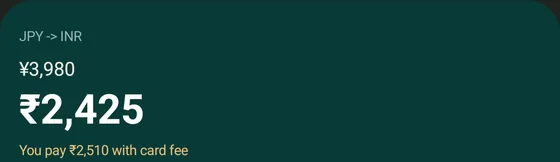
Your card issuer may add a foreign transaction fee, often a few percent, on top of the rate. When a machine asks whether to pay in your home currency or the local one, choose the local one: the home-currency option is dynamic currency conversion (DCC), where the merchant sets the rate, and it is usually worse. Real cost = price × rate × (1 + fee). Example: 2,425 at the market rate becomes 2,510 with a 3.5 percent fee.
The fees that can apply
Paying abroad can involve several separate charges. Not all apply to every card, so check your own terms.
- Foreign transaction fee. A percentage the card issuer adds to purchases made in another currency or abroad. It is commonly somewhere between zero and about 3.5 percent, depending on the card.
- The exchange rate itself. Cards use a network or issuer rate, which is close to the market rate but not the same.
- Merchant surcharge. Some businesses add a card fee at the till.
- ATM fees. The ATM operator may charge a fee, and your bank may charge too.
- Dynamic currency conversion. Described below.
The formula
Real cost = price × exchange rate × (1 + fee percentage / 100)Example: a price of ¥3,980 at a market rate that makes it ₹2,425, with a 3.5 percent card fee, costs 2,425 × 1.035 = ₹2,510. The fee is ₹85 on a purchase of about the price of a good dinner. Over a two-week trip of daily card spending the amount adds up.
Real cost calculator
Enter the price on the tag, the rate (how much one unit of the foreign currency is worth in your home currency) and your card fee. Everything runs on your device.
Real cost calculator
Price × rate, plus card fee.
DCC: the question at the till
When you pay by card abroad, the machine sometimes asks whether you would like to pay in your home currency or the local currency. Paying in your home currency sounds helpful, because you see the final figure. That is dynamic currency conversion. The conversion is done by the merchant's side, at a rate they set, which usually includes a margin. Your own card network or issuer rate is normally better.
- Choose the local currency.
- If the screen shows two totals, compare them. The home-currency total is often higher.
- You can ask the cashier to run it again if you chose wrongly, before you sign.
DCC is legal and sometimes disclosed in small print. It is not a scam, just usually a worse deal.
Cash and ATMs
Withdrawing local cash from a bank ATM often costs less than exchanging at an airport kiosk. The same advice applies: if the ATM offers to convert into your home currency, decline and take the local currency. Note any fee the ATM shows before you accept. A few larger withdrawals usually cost less than many small ones, but carry only what you need.
Seven habits that save money
- Know your card's foreign transaction fee before you leave, and use a card with a low or zero fee if you have one.
- Always choose the local currency at the till and the ATM.
- Keep a small amount of cash for places that do not take cards.
- Check the total on the machine before you tap.
- Add the fee to your estimate, not just the market rate.
- Watch for a merchant surcharge.
- Save expenses as you go, and check the real cost against your statement later.
Keep the market rate and the real cost apart
Here & Home shows the market rate on top and the real cost beneath it, with your card fee, tax and tip set once. The two are kept apart so that you can see what the fee costs you. See how the converter works and how to set a daily budget.
Questions people ask
What is a foreign transaction fee?
A percentage a card issuer may add to purchases in another currency or abroad. It is commonly between zero and about 3.5 percent, depending on the card.
What is dynamic currency conversion?
When a merchant or ATM offers to charge you in your home currency at its own rate. It is usually worse than paying in the local currency.
Should I pay in local currency or my home currency?
In the local currency, in most cases. Your card network or issuer rate is normally better than the merchant's.
How do I work out the real cost of a card payment?
Multiply the price by the exchange rate, then by one plus the fee percentage over 100.
Do all cards charge a foreign transaction fee?
No. Some cards have none. Check your card's terms.
Does Here & Home include card fees?
Yes. Set your card fee, tax and tip once, and the real cost is shown beneath the market rate, kept apart.
Keep reading
Know the real price
Here & Home is free on Google Play. Market rate on top, real cost beneath.

For reference. Steps and screens described here are as they appear in Here & Home, and menu names can differ between versions of Android and the app. Exchange rates and prices in examples are illustrative, and rates in Here & Home are indicative, updated periodically and not financial quotes. Emergency numbers, phrases, country facts and survival tips are general information given on a best-effort basis: check them before you travel, and do not rely on any app alone in a life-threatening emergency. Here & Home is a field companion, not a financial or emergency service. Trademarks are those of their owners and are used only to describe what the app works with.