Steel plate weighs 40.8 pounds per square foot for every inch of thickness. A 1/4 in plate is 10.2 lb/ft², so a 4 × 8 ft sheet (32 ft²) weighs 327 lb. A 1/2 in plate is 20.4 lb/ft² and a 4 × 8 sheet weighs 653 lb. Thin sheet is sold by gauge, and 16 gauge is 2.5 lb/ft².
The formula
Steel weighs 490 lb per cubic foot. A plate one foot square and one inch thick is 1/12 of a cubic foot, so it weighs 490 / 12 = 40.83 lb. The weight per square foot is then:
lb per ft² = thickness in inches × 40.83Multiply by the area for the weight of a plate: weight = lb/ft² × length (ft) × width (ft). For metric, multiply lb/ft² by 4.882 to get kg/m². The general shape formulas are in the weight and cost guide.
Plate weight chart
Plate is generally the material 3/16 in and thicker, and thinner material is called sheet. The exact boundary depends on width and the product specification. A 4 × 8 ft sheet is 32 ft² and a 5 × 10 ft sheet is 50 ft².
| Thickness | lb per ft² | lb per 4 × 8 ft sheet | lb per 5 × 10 ft sheet | kg per m² |
|---|---|---|---|---|
| 3/16 in | 7.7 | 245.0 | 383 | 37.4 |
| 1/4 in | 10.2 | 326.7 | 510 | 49.8 |
| 5/16 in | 12.8 | 408.3 | 638 | 62.3 |
| 3/8 in | 15.3 | 490.0 | 766 | 74.8 |
| 1/2 in | 20.4 | 653.3 | 1021 | 99.7 |
| 5/8 in | 25.5 | 816.7 | 1276 | 124.6 |
| 3/4 in | 30.6 | 980.0 | 1531 | 149.5 |
| 7/8 in | 35.7 | 1143.3 | 1786 | 174.4 |
| 1 in | 40.8 | 1306.7 | 2042 | 199.4 |
| 1-1/4 in | 51.0 | 1633.3 | 2552 | 249.2 |
| 1-1/2 in | 61.2 | 1960.0 | 3062 | 299.0 |
| 2 in | 81.7 | 2613.3 | 4083 | 398.7 |
These are theoretical weights. Plate is rolled to thickness and weight tolerances, and a mill plate can come in a little over or under. If you buy by weight, the scale ticket governs.
Sheet gauge chart
Thin sheet steel is sold by gauge number. A smaller gauge number is thicker. The table uses the Manufacturers' Standard Gauge for uncoated carbon steel sheet. Galvanized sheet and other metals use different gauge tables, so check the one that applies to your product.
| Gauge | Thickness (in) | lb per ft² | lb per 4 × 8 ft sheet | lb per ft² from density |
|---|---|---|---|---|
| 10 gauge | 0.1345 | 5.625 | 180.0 | 5.49 |
| 11 gauge | 0.1196 | 5.000 | 160.0 | 4.88 |
| 12 gauge | 0.1046 | 4.375 | 140.0 | 4.27 |
| 13 gauge | 0.0897 | 3.750 | 120.0 | 3.66 |
| 14 gauge | 0.0747 | 3.125 | 100.0 | 3.05 |
| 16 gauge | 0.0598 | 2.500 | 80.0 | 2.44 |
| 18 gauge | 0.0478 | 2.000 | 64.0 | 1.95 |
| 20 gauge | 0.0359 | 1.500 | 48.0 | 1.47 |
| 22 gauge | 0.0299 | 1.250 | 40.0 | 1.22 |
| 24 gauge | 0.0239 | 1.000 | 32.0 | 0.98 |
| 26 gauge | 0.0179 | 0.750 | 24.0 | 0.73 |
| 28 gauge | 0.0149 | 0.625 | 20.0 | 0.61 |
The last column shows what the density formula gives for the same thickness. The gauge standard builds in a slightly heavier basis, 41.82 lb per square foot per inch of thickness, so the gauge weights run about 2 percent above the density figure. For a weight quote, use the number your supplier lists. For a quick estimate, either works.
Worked example
A job needs six 4 × 8 ft sheets of 3/8 in plate and ten 4 × 8 ft sheets of 16 gauge.
- 3/8 in plate: 0.375 × 40.83 = 15.31 lb/ft², so one sheet is 490 lb and six are 2,940 lb.
- 16 gauge: 2.5 lb/ft², so one sheet is 80 lb and ten are 800 lb.
- Total: 3,740 lb. At $0.55 per pound that is $2,057.00.
Sheet and plate are often priced differently, so give each its own price. The price conversion guide shows how to turn a price per hundredweight into a price per pound.
Mistakes to avoid
- Gauge number read as inches. 16 gauge is 0.0598 in, not 16.
- Different gauge tables. Galvanized, stainless and aluminum sheet each use their own thicknesses for the same gauge number.
- Area units. The chart is per square foot. A sheet that is 48 × 96 in is 32 ft², not 4608.
- Ton ambiguity. A short ton is 2,000 lb and a metric tonne is 2,204.6 lb.
- Ignoring tolerance. A weighed plate can differ from the chart by a few percent.
Any thickness in the app
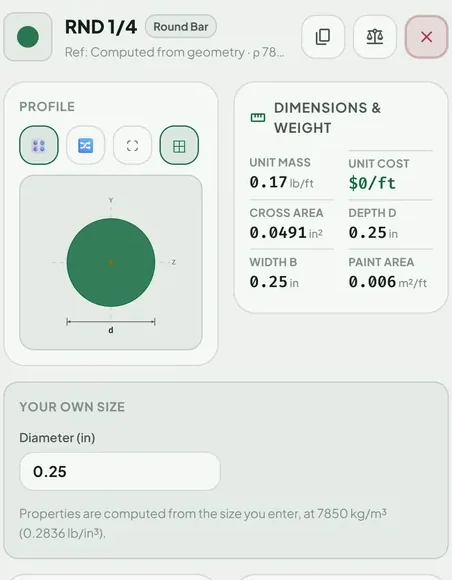
For a thickness the chart does not list, open Plate or Sheet in Steel Table USA, tap the control button and type your own dimensions. The properties recalculate and the cost shows in dollars per square foot at your own price. The app computes from density, so it matches the plate column of the chart.
Questions people ask
How much does a 1/4 inch steel plate weigh per square foot?
About 10.2 pounds per square foot. A 4 × 8 ft sheet of 1/4 in plate weighs about 327 lb.
How much does a 4x8 sheet of 1/2 inch steel plate weigh?
About 653 pounds, from 20.4 lb/ft² times 32 ft².
How much does 16 gauge steel weigh per square foot?
Under the Manufacturers' Standard Gauge, 16 gauge is 0.0598 in thick and weighs 2.5 lb/ft².
What is the difference between plate and sheet?
Plate is thicker, generally 3/16 in and up. Sheet is thinner and is sold by gauge. The boundary depends on width and the product specification.
Why do gauge weights differ from the density formula?
The gauge standard uses a basis of 41.82 lb per square foot per inch of thickness, about 2 percent heavier than the 40.83 lb from 490 lb/ft³.
How do I convert plate weight to metric?
Multiply pounds per square foot by 4.882 to get kilograms per square metre.
Keep reading
Any plate or sheet size, instantly
Steel Table USA computes weight and cost per square foot for the size you type. Free on Google Play.

For reference, not for sign-off. Weights are theoretical, worked from a density of 490 lb per cubic foot, and prices are examples. Rolled shape weights are as shown in Steel Table USA from the AISC Shapes Database v16.0. Delivered weight differs slightly from theoretical weight because of rolling tolerances, so confirm quantities and prices with your supplier before ordering. The AISC Shapes Database is published by the American Institute of Steel Construction. Steel Table USA is an independent app and is not affiliated with or endorsed by AISC.