Trip budget = (daily spending x days) + one-off costs, plus a buffer of about 10%. For a 7 day trip with 60 for the stay, 25 for food and 10 for transport each day, plus 150 for activities and 15 for data, that comes to 913. Take a small amount of cash for the first day and small purchases, and pay for the rest by card, in the local currency. Here & Home shows how much cash you have left and how many days it should last.
The formula
Start from what you will spend each day, then add the one-off costs, then add a cushion.
Trip budget = (stay + food + transport) × days + activities + data + bufferUse real prices: look up typical nightly rates, a restaurant meal and a day's local transport for your destination. A daily budget then becomes a single number you can compare every price with.
Worked example, 7 days
These figures are illustrative, in US dollars. Replace them with prices for your own trip.
| Item | Per day | Days | Total |
|---|---|---|---|
| Stay | 60 | 7 | 420 |
| Food and drink | 25 | 7 | 175 |
| Local transport | 10 | 7 | 70 |
| Activities (whole trip) | 150 | ||
| Phone data (whole trip) | 15 | ||
| Subtotal | 830 | ||
| Buffer, 10% of subtotal | 83 | ||
| Trip budget | 913 |
Check: 420 + 175 + 70 + 150 + 15 = 830. A 10% buffer is 83, so the trip budget is 913, or about 130 a day. The buffer covers the things nobody plans for: a taxi at night, a gift, a meal that costs more than you expected.
Cash or card
| Cash | Card | |
|---|---|---|
| Best for | Street food, markets, small shops, tips, local transport | Hotels, big shops, restaurants, tickets, online bookings |
| Watch out for | Loss and theft, poor exchange rates, leftover coins | Foreign transaction fees, ATM charges, paying in your home currency |
| Rule of thumb | Enough for the first day and for small items | Everything else, in the local currency |
Practices differ by country. Some places are almost cashless and others still run on cash, so look up your destination. In the sample trip in the app, about a third of spending was cash and two thirds card, but your own mix will depend on where you go.
ATMs and exchange desks
- Machines inside a bank are usually safer than free-standing ones on the street.
- Choose the local currency when a machine or card terminal offers to charge you in your own. That offer is called dynamic currency conversion, and it usually costs more. See card fees and DCC explained.
- Fewer, larger withdrawals can cost less if each one carries a fixed fee, but do not carry more cash than you are comfortable losing.
- Airport desks often give weaker rates. Take only what you need to get to your stay.
Track cash as you spend
The danger with cash is not knowing what is left. Note what you took out, save each cash expense, and compare the pace of spending with the days remaining. In Here & Home the Wallet shows cash taken out, how much is spent, how much is still in your pocket and a rough estimate of how many more days it will last.
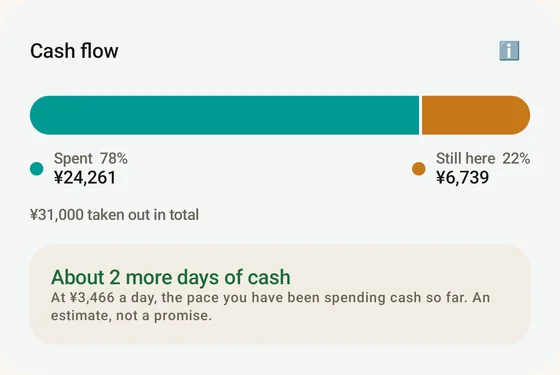
The card gives an estimate based on your spending so far, not a promise.
Tips to cut the risk
- Split your money between two places, for example a wallet and a bag, and keep a backup card apart from your main one.
- Keep a small amount of spare cash for emergencies, separate from your daily money.
- Do not exchange all your cash at once. Take it out in stages as you need it.
- Check your card statement each evening, or save expenses in the app as you go, so a wrong charge is easy to catch.
Questions people ask
How much money should I take abroad?
Add up daily costs for the number of days, add one-off costs such as activities and data, and add a buffer of around 10%.
How much cash should I carry?
Enough for the first day and for small purchases, with a card for everything else. Customs and local practice differ, so check your destination.
Is it better to use cash or card abroad?
Card is usually fine for hotels, shops and restaurants, and cash helps for markets, street food and small purchases. Pay by card in the local currency.
Where should I get local cash?
A machine inside a bank is usually safer than a free-standing one. Airport exchange desks often give weaker rates.
How do I know how long my cash will last?
Compare what is left with your daily pace of spending. Here & Home's Wallet estimates how many more days your cash should last.
Do I need a buffer?
Yes. Around 10% extra covers the unplanned costs every trip has.
Keep reading
Know what is left
Here & Home is free on Google Play. Track cash and card spending as you travel.

For reference. Steps and screens described here are as they appear in Here & Home, and menu names can differ between versions of Android and the app. Exchange rates and prices in examples are illustrative, and rates in Here & Home are indicative, updated periodically and not financial quotes. Emergency numbers, phrases, country facts and survival tips are general information given on a best-effort basis: check them before you travel, and do not rely on any app alone in a life-threatening emergency. Here & Home is a field companion, not a financial or emergency service. Trademarks are those of their owners and are used only to describe what the app works with.