Before your first trip abroad: check passport validity and visa rules, buy travel insurance, keep copies of your documents, sort a card with low foreign fees and a little cash, plan phone data, pack the right plug adapter, and save emergency numbers offline. On arrival, convert prices before you pay, record spending daily, and avoid paying in your home currency at the till. Here & Home covers the money and offline-help parts from your home screen.
Documents and rules
- Passport validity. Many countries want a passport valid for several months after you leave, often six. Check the rule for each country on your route, including stopovers.
- Visa or e-visa. Some countries need one before you fly. Use the official government site, not a lookalike.
- Travel insurance. Check that it covers medical care, lost bags and cancellations, and keep the policy number and helpline where you can read them offline.
- Copies. Keep a photo of your passport, visa, insurance and bookings on your phone, plus one paper set in a different bag.
- Address of your stay written down in the local script if you can, for taxi drivers.
Money
- Know the currency. Learn the rough rate and the number of zeros. See currencies with many zeros and converting in your head.
- Carry two ways to pay. Take at least two cards, kept in different places, and a small amount of cash for the first day.
- Ask about fees. Find out your card's foreign transaction fee and ATM charges. See card fees and DCC explained.
- Set a daily budget before you go, so each price has context. See how to set a daily budget.
- Plan how much to bring. See how much money to take abroad.
- Tell your bank if it asks you to, and check that international payments are switched on for your cards.
Phone and power
- Data. Decide between your home roaming plan, a local SIM or an eSIM. Roaming can be expensive, so check the daily price first.
- Offline maps of your destination, downloaded over Wi-Fi at home.
- Plug adapter and voltage. Check the socket type and voltage before you pack. See the country guide.
- Power bank and short cable. Airlines usually require power banks in hand luggage.
- Two clocks for home and where you are, so you know when to call. See time difference and calling home.
Safety and help
- Save the local emergency numbers where you can reach them with no signal. See emergency numbers abroad.
- Save a few key phrases for help, a doctor and the police. See emergency phrases.
- Share your itinerary with someone at home.
- Find the address of your embassy or consulate and keep it with your documents.
- Keep valuables out of back pockets, and never leave a phone on a cafe table.
When you land
- Connect to data or Wi-Fi, and switch your phone to the local time.
- Get a little local cash, preferably from a bank or a machine inside a bank, rather than from the first exchange desk you see.
- Convert before you pay. Check the price in your home currency before you hand over money.
- Pay in the local currency when a card machine asks, to avoid the machine's own rate.
- Save every expense on the day, even small ones, while you still remember them.
The three first-timer surprises
| Surprise | What happens | The fix |
|---|---|---|
| Prices you cannot feel | Everything looks cheap, or a rip-off, and you cannot tell which | Convert every price in three seconds, and learn a few anchor prices |
| Losing track of spending | By day four you do not know what you have spent | Save each expense and compare it with a daily budget |
| Something goes wrong | You do not speak the language and have no signal | Keep emergency numbers and phrases saved offline |
Where Here & Home fits
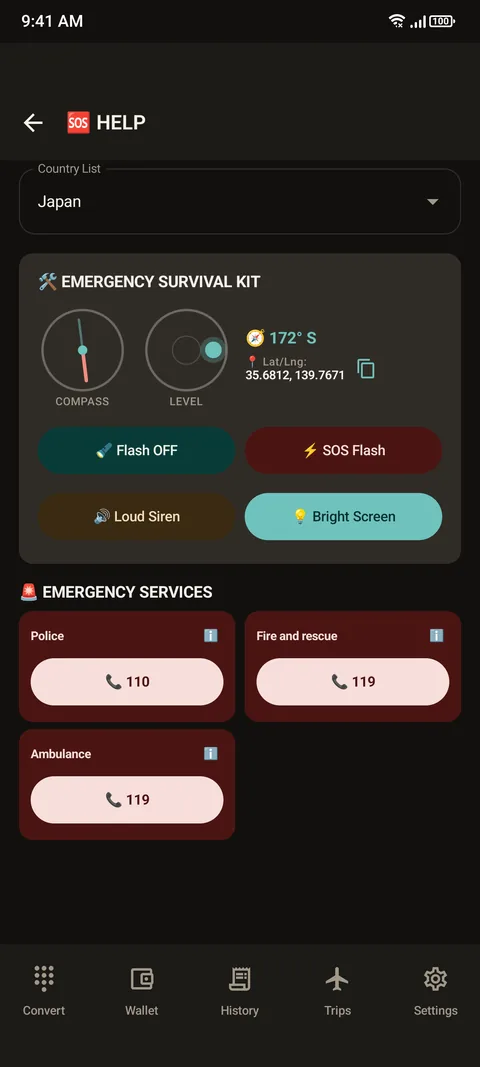
Here & Home is built around those three surprises. Tap the clock on your home screen and the converter opens, so you can type a price and see it in your home currency in about three seconds. Save it to your trip, so you can see where your money went. Travelling with friends? Share the trip and settle up fairly. If something goes wrong, the Help section keeps emergency numbers and phrases on your phone, offline. See the app tour for the rest.
Do this checklist a week before you fly, not the night before. Rules for visas, passports, bags and power banks change, so check the official sources for your route.
Questions people ask
What should I do before my first international trip?
Check passport validity and visa rules, buy travel insurance, keep copies of your documents, sort cards and a little cash, plan phone data, pack the right plug adapter and save emergency numbers offline.
How early should I prepare for a first trip abroad?
Start a few weeks ahead for visas and insurance, and run through the rest of the checklist about a week before you fly.
How much cash should a first-time traveller take?
Enough for the first day and small purchases, with cards for the rest. See the post on how much money to take abroad for a method.
Should I pay in my home currency or the local one?
Pay in the local currency when a card machine offers a choice. Paying in your home currency often uses the machine's own, less favourable rate.
How do I keep track of spending abroad?
Save each expense on the day and compare it with a daily budget. Here & Home lets you convert and save a price in a few taps.
What if I need help and do not speak the language?
Save emergency numbers and a few key phrases offline before you go. Here & Home keeps both in its Help section.
Keep reading
Your first trip abroad, made easier
Here & Home is free on Google Play. Convert, track and stay safe from your home screen.

For reference. Steps and screens described here are as they appear in Here & Home, and menu names can differ between versions of Android and the app. Exchange rates and prices in examples are illustrative, and rates in Here & Home are indicative, updated periodically and not financial quotes. Emergency numbers, phrases, country facts and survival tips are general information given on a best-effort basis: check them before you travel, and do not rely on any app alone in a life-threatening emergency. Here & Home is a field companion, not a financial or emergency service. Trademarks are those of their owners and are used only to describe what the app works with.