A name like W12x26 is a wide-flange shape, about 12 inches deep, weighing 26 pounds per foot. The table beside it lists the properties you need: area A = 7.65 in², depth d = 12.2 in, flange width bf = 6.49 in, strong-axis moment of inertia Ix = 204 in⁴, elastic modulus Sx = 33.4 in³ and plastic modulus Zx = 37.2 in³. Strong axis is x, weak axis is y.
Reading a shape name
AISC shape names are short codes. The first letters give the family, and the numbers give size. For a wide-flange beam:
W 12 x 26W = wide flange | 12 = nominal depth in inches | 26 = weight in pounds per foot
So a W12x26 is roughly 12 inches deep and weighs 26 lb per foot. A W18x35 is roughly 18 inches deep and weighs 35 lb per foot. Two shapes with the same first number and a heavier second number have more steel in the flanges, the web, or both.
W, S, M, HP, C, MC, L, WT and HSS: the families
| Family | Example | What the numbers mean |
|---|---|---|
| W (wide flange) | W12x26 | Nominal depth (in) x weight (lb/ft). Parallel flange faces. |
| S (American standard beam) | S12x31.8 | Depth (in) x weight (lb/ft). Sloped inner flange faces. |
| M (miscellaneous beam) | M10x9 | Depth (in) x weight (lb/ft). Light beams that do not fit the W or S series. |
| HP (bearing pile) | HP12x53 | Nominal depth (in) x weight (lb/ft). Flange and web are about equal thickness. |
| C (American standard channel) | C9x15 | Depth (in) x weight (lb/ft). |
| MC (miscellaneous channel) | MC18x42.7 | Depth (in) x weight (lb/ft). |
| L (angle) | L4x4x1/2 | Leg length x leg length x thickness, all in inches. The weight is not in the name. |
| WT (tee cut from a W) | WT6x13 | Depth (in) x weight (lb/ft). A WT6x13 is half of a W12x26. |
| HSS (rectangular) | HSS6x4x1/4 | Outside height x outside width x nominal wall, in inches. |
| HSS (round) | HSS6.000x0.250 | Outside diameter x nominal wall, in inches. |
| Pipe | Pipe 6 STD | Nominal pipe size and wall class (STD, XS, XXS). |
The WT row has a useful consequence. Cut a W12x26 down its web and each piece is a WT6x13, so the tee weighs exactly half the beam.
Why a W12 is not 12 inches deep
The first number in a W name is the nominal depth, rounded to the nearest inch. The actual depth d varies within a series, mostly because the flange thickness changes from one weight to the next. Here is the W12 series from the AISC Shapes Database.
| Shape | Weight (lb/ft) | Actual depth d (in) | Flange width bf (in) | Ix (in⁴) |
|---|---|---|---|---|
| W12x14 | 14 | 11.90 | 3.97 | 88.6 |
| W12x19 | 19 | 12.20 | 4.01 | 130 |
| W12x26 | 26 | 12.20 | 6.49 | 204 |
| W12x35 | 35 | 12.50 | 6.56 | 285 |
| W12x50 | 50 | 12.20 | 8.08 | 391 |
| W12x65 | 65 | 12.10 | 12.00 | 533 |
| W12x96 | 96 | 12.70 | 12.20 | 833 |
| W12x152 | 152 | 13.70 | 12.50 | 1430 |
The W12x14 is 11.9 in deep and the W12x152 is 13.7 in deep. If a beam has to fit a 12 in space, check d, not the name.
Every column, followed through W12x26
These are the columns you will use most. The right-hand column is the W12x26 row from the database. Below, the same numbers as Steel Table USA shows them.
| Symbol | What it is | Units | W12x26 |
|---|---|---|---|
| A | Cross-section area | in² | 7.65 |
| d | Overall depth | in | 12.2 |
| bf | Flange width | in | 6.49 |
| tw | Web thickness | in | 0.230 |
| tf | Flange thickness | in | 0.380 |
| k | Distance from outer face of flange to web toe of fillet | in | 0.680 |
| Ix | Moment of inertia, strong axis | in⁴ | 204 |
| Sx | Elastic section modulus, strong axis | in³ | 33.4 |
| rx | Radius of gyration, strong axis | in | 5.17 |
| Zx | Plastic section modulus, strong axis | in³ | 37.2 |
| Iy | Moment of inertia, weak axis | in⁴ | 17.3 |
| Sy | Elastic section modulus, weak axis | in³ | 5.34 |
| ry | Radius of gyration, weak axis | in | 1.51 |
| Zy | Plastic section modulus, weak axis | in³ | 8.17 |
| J | Torsional constant | in⁴ | 0.300 |
| Cw | Warping constant | in⁶ | 607 |
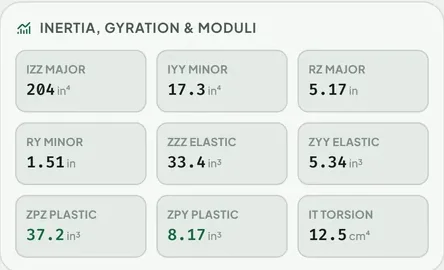
Two more columns appear in a full table. T is the distance between the web toes of the fillets, the flat part of the web. For W12x26 it is 10 1/8 in. ho is the distance between the centroids of the two flanges, 11.8 in, which comes up in lateral-torsional buckling.
Strong axis and weak axis
An I-shape bends much more easily about the weak axis. Compare the two moments of inertia of W12x26: Ix = 204 in⁴ and Iy = 17.3 in⁴. The strong axis is about twelve times stiffer. That is why beams are loaded in the strong direction and why columns usually buckle about the weak axis.
The radius of gyration follows the same pattern. rx = 5.17 in and ry = 1.51 in. In a column check, the smaller r gives the larger slenderness and usually governs. The guide to slenderness ratio works an example.
Which modulus do I use?
- Plastic modulus Zx for the nominal bending strength of a compact beam: Mn = Fy Zx. The beam capacity guide uses it.
- Elastic modulus Sx for stress at the extreme fiber under service load: stress = M / Sx.
- Moment of inertia Ix for deflection, never the modulus.
- Radius of gyration r for column slenderness, KL/r.
- Area A for axial tension and compression, and for weight.
Inch and metric columns
The AISC database has both inch-pound and metric columns, for example weight in lb/ft and mass in kg/m. The metric values are AISC's own columns, not converted by a third party. The same shape can therefore be quoted as W12x26 or W310x38.7. Steel Table USA lets you switch between the two in the menu.
Look it up in Steel Table USA
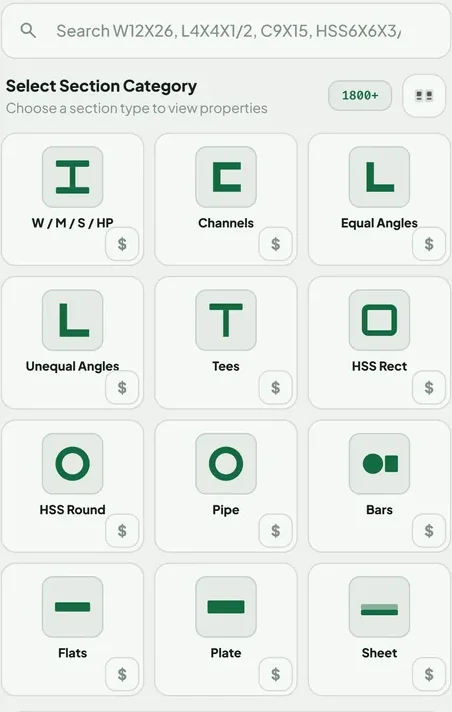
Type a name in the search bar, for example W12x26, L4x4x1/2 or C9x15. The card shows weight per foot. Tap Inspect for the scaled sketch with its axes and center of gravity, the dimensions, and every property in the table above. The symbol button on the sketch switches between letters (D, B, t, T) and measured values.
Questions people ask
What does W12x26 mean?
It is a wide-flange shape with a nominal depth of 12 inches that weighs 26 pounds per foot. Its actual depth is 12.2 in.
What is the difference between a W and an S shape?
A W-shape has parallel flange faces. An S-shape, the American standard beam, has flanges whose inner faces slope. W-shapes are more efficient and far more common in current design.
What does L4x4x1/2 mean?
It is an angle with two 4 inch legs and a thickness of 1/2 inch. The weight, 12.8 lb/ft, is not in the name, so look it up.
What is the difference between Ix and Sx?
Ix is the moment of inertia and governs deflection. Sx is the elastic section modulus, Ix divided by the distance to the extreme fiber, and governs stress. For W12x26, Ix = 204 in⁴ and Sx = 33.4 in³.
What is the difference between Sx and Zx?
Sx is the elastic modulus. Zx is the plastic modulus, and it is larger because it counts the whole section yielding. For W12x26, Zx = 37.2 in³ against Sx = 33.4 in³. Compact beams use Zx for bending strength.
Which AISC Shapes Database version does Steel Table USA use?
The app uses AISC Shapes Database v16.0, which is consistent with the 16th edition of the AISC Steel Construction Manual. The source is shown as Ref: on every Inspect panel.
Keep reading
Every AISC shape on your phone
Steel Table USA holds the full shapes database offline, with a scaled sketch and every property for each shape. Free on Google Play.

For reference, not for sign-off. Shape and bolt values quoted here are as shown in Steel Table USA, which takes rolled shape data from the AISC Shapes Database v16.0 and bolt tables from the RCSC Specification (2020), and the worked examples follow AISC 360 methods under the simplifying assumptions stated in the text. Transcription can contain errors. Check critical values against the AISC Steel Construction Manual and the RCSC Specification, and have designs checked by a licensed engineer. The AISC Specification, Manual and Shapes Database are published by the American Institute of Steel Construction, and the RCSC Specification by the Research Council on Structural Connections. Steel Table USA is an independent app and is not affiliated with or endorsed by either organization.