For a doubly symmetric I-shape, Ix = (bf d³ − (bf − tw)(d − 2tf)³) / 12, and the elastic section modulus is Sx = Ix / (d / 2). For W12x26 the hand formula gives 201.0 in⁴ against the table value of 204 in⁴, about 1.5 percent low, because it leaves out the fillets where web meets flange.
What I, S and Z are
The moment of inertia I (the second moment of area) measures how a cross section resists bending. It depends on how far the material sits from the bending axis, and the distance counts twice, so material far from the axis is worth much more than material near it. That is why a beam is shaped like an I.
The elastic section modulus S is I divided by the distance from the axis to the extreme fiber. It links a bending moment to the stress at the surface. The plastic section modulus Z is the same idea with the whole section at yield. It is always larger than S.
S = I / c stress = M / SThe rectangle: where everything starts
For a rectangle of width b and depth h, about the axis through its centroid parallel to the width:
I = b × h³ / 12Depth is cubed. Doubling the depth of a rectangular beam makes it eight times stiffer but only twice as heavy. An I-shape is a rectangle with the least useful material, the middle, taken out.
The I-shape formulas
Treat the I-shape as a big outer rectangle bf × d with two rectangular gaps cut from the sides. The gaps together are (bf − tw) wide and (d − 2tf) deep:
Ix = [ bf d³ − (bf − tw)(d − 2tf)³ ] / 12Iy = [ 2 tf bf³ + (d − 2tf) tw³ ] / 12
Zx = bf tf (d − tf) + tw (d − 2tf)² / 4
The area is A = 2 bf tf + (d − 2tf) tw. All of these ignore the fillets where the web meets the flange, so they read slightly low for a rolled shape.
Checked against W12x26
Take the values of W12x26 from the AISC Shapes Database: bf = 6.49 in, d = 12.2 in, tf = 0.380 in and tw = 0.230 in.
- d − 2tf = 12.2 − 0.76 = 11.44 in
- bf d³ = 6.49 × 1,815.8 = 11,785 in⁴
- (bf − tw)(d − 2tf)³ = 6.26 × 1,497.1 = 9,372 in⁴
- Ix = (11,785 − 9,372) / 12 = 201.0 in⁴
| Property | Hand formula | AISC table | Difference |
|---|---|---|---|
| Area A | 7.56 in² | 7.65 in² | 1.1% |
| Ix | 201.0 in⁴ | 204 in⁴ | 1.5% |
| Sx = Ix / (d / 2) | 33.0 in³ | 33.4 in³ | 1.3% |
| Zx | 36.7 in³ | 37.2 in³ | 1.4% |
| Iy | 17.3 in⁴ | 17.3 in⁴ | 0.1% |
The hand figures are about 1 to 1.5 percent low about the strong axis. The fillets add a little material at the web and flange junction. About the weak axis the match is almost exact, because the fillets sit close to the axis and add almost nothing there. For learning and for a quick check the hand formula is good enough. For a design, use the table value, as the guide to reading a shape table explains.
A built-up girder and the parallel axis theorem
When a section is made of plates welded together, there is no table. Use the parallel axis theorem: the moment of inertia of each part about the overall axis is its own I plus its area times the square of the distance from its centroid to that axis.
Take a plate girder with two flange plates 10 in × 1 in and a web plate 24 in × 1/2 in. The overall depth is 24 + 2 = 26 in.
- Web: 0.5 × 24³ / 12 = 576 in⁴, centered on the axis.
- Each flange: own I = 10 × 1³ / 12 = 0.833 in⁴, area 10 in², centroid 12.5 in from the axis. Parallel axis term: 10 × 12.5² = 1,562.5 in⁴.
- Total: 576 + 2 × (0.833 + 1,562.5) = 3,702.7 in⁴.
The outer-minus-inner formula gives the same number: (10 × 26³ − 9.5 × 24³) / 12 = 3,702.7 in⁴. Then Sx = 3,702.7 / 13 = 284.8 in³, the area is 32 in², and the weight is 32 × 3.403 = 108.9 lb/ft. The plastic modulus is Zx = 322 in³, which is 1.13 times Sx. Rolled I-shapes are usually between 1.1 and 1.2.
Where each number is used
- Ix for deflection of a beam, and for choosing the lightest shape that meets a limit. See how to pick the lightest section.
- Sx for bending stress at service load.
- Zx for the nominal bending strength of a compact beam, Mn = Fy Zx. See how to check a beam to AISC 360.
- I and area together give the radius of gyration, r = √(I / A), used in column slenderness. See the slenderness guide.
Skip the arithmetic
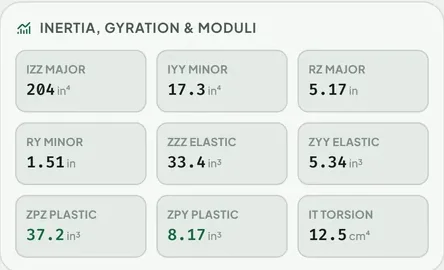
Steel Table USA lists I, r, S and Z for both axes of every shape in the Inspect panel, straight from the AISC Shapes Database. For a plate, bar or flat in your own size, it computes them from geometry. For W12x26 the panel shows Izz = 204 in⁴, Iyy = 17.3 in⁴, elastic moduli 33.4 and 5.34 in³, and plastic moduli 37.2 and 8.17 in³. The app calls the strong axis z and the weak axis y.
Questions people ask
What is the formula for the moment of inertia of an I-beam?
Ix = [bf d³ − (bf − tw)(d − 2tf)³] / 12 for a doubly symmetric I-shape, ignoring fillets.
What is the difference between section modulus S and Z?
S is the elastic section modulus, I divided by the distance to the extreme fiber. Z is the plastic section modulus. For W12x26, Sx = 33.4 in³ and Zx = 37.2 in³.
How do I calculate the section modulus of a W-shape?
Divide Ix by half the depth. For W12x26, 204 / 6.1 = 33.4 in³.
Why does my hand calculation differ from the AISC table?
The hand formula ignores the fillets between web and flange, so it reads about 1 to 1.5 percent low for the strong axis of a rolled shape.
How do I find the moment of inertia of a built-up section?
Use the parallel axis theorem: add each part's own I and its area times the squared distance from its centroid to the overall centroid.
Which moment of inertia should I use for deflection?
The one about the axis of bending, almost always Ix for a beam loaded in the strong direction.
Keep reading
Skip the arithmetic
Steel Table USA lists I, S, Z and r for every AISC shape, offline. Free on Google Play.

For reference, not for sign-off. Shape and bolt values quoted here are as shown in Steel Table USA, which takes rolled shape data from the AISC Shapes Database v16.0 and bolt tables from the RCSC Specification (2020), and the worked examples follow AISC 360 methods under the simplifying assumptions stated in the text. Transcription can contain errors. Check critical values against the AISC Steel Construction Manual and the RCSC Specification, and have designs checked by a licensed engineer. The AISC Specification, Manual and Shapes Database are published by the American Institute of Steel Construction, and the RCSC Specification by the Research Council on Structural Connections. Steel Table USA is an independent app and is not affiliated with or endorsed by either organization.