When deflection governs, work backward from the limit: Irequired = 5wL⁴ / (384 E δlimit). For a 24 ft span carrying 1.0 kip/ft with a limit of L/360, the required Ix is 322 in⁴. Then list the shapes with at least that Ix and take the lightest. Here it is the W16x31 at 31 lb/ft with Ix = 375 in⁴. Strength and bracing still need their own checks.
Why start from stiffness
Many beams are chosen by strength. Long spans and light floors are often chosen by deflection instead. A floor that bounces or a beam that sags past its limit fails the serviceability check even if it has plenty of strength. In that case the question to ask first is: what moment of inertia do I need?
Weight matters because steel is bought by the pound. Two shapes with the same stiffness can differ in weight by 20 percent, and the lighter one costs less to buy, ship and lift.
From deflection limit to required I
For a simply supported beam with a uniform service load w over span L, the midspan deflection is δ = 5wL⁴ / (384EI). Rearrange it to find the I that just meets a limit:
Irequired = 5 × w × L⁴ / (384 × E × δlimit)E is 29,000 ksi for steel. Use kips and inches so the units cancel to in⁴. The limit is usually a fraction of the span: L/360 is common for floor live load, L/240 for total load on a floor, and roofs vary. The governing code and the finishes the beam supports set the limit, so look up the one that applies.
Worked example, 24 ft span
A simply supported floor beam spans 24 ft and carries a service load of 1.0 kip/ft. The deflection limit is L/360.
- L = 24 × 12 = 288 in
- δlimit = 288 / 360 = 0.800 in
- w = 1.0 kip/ft = 0.0833 kip/in
- Irequired = 5 × 0.0833 × 288⁴ / (384 × 29,000 × 0.800) = 322 in⁴
Any shape with Ix at or above 322 in⁴ meets the deflection limit. Now list them by weight.
Ranking the candidates
Here are the six lightest shapes in the W, S, M, C, MC and HSS tables with Ix at least 322 in⁴. The cost column uses the example price of $0.55 per pound.
| Shape | Weight (lb/ft) | Ix (in⁴) | Ix / required | Cost per foot at $0.55/lb |
|---|---|---|---|---|
| W16x31 | 31 | 375 | 1.17 | $17 |
| W14x34 | 34 | 340 | 1.06 | $19 |
| W18x35 | 35 | 510 | 1.59 | $19 |
| W16x36 | 36 | 448 | 1.39 | $20 |
| W14x38 | 38 | 385 | 1.20 | $21 |
| HSS20x4x1/4 | 39.43 | 458 | 1.42 | $22 |
The W16x31 is the lightest, and it has about 17 percent more stiffness than required, which is a good margin. The W14x34 is next and meets the limit by only 6 percent. Note that every row has to be checked in the strong direction, since Ix is the strong-axis value. A tube or channel orientation may differ in a real frame.
The table was computed from the AISC Shapes Database values. The app's Optimizer ranks the same data, so the lightest result should agree.
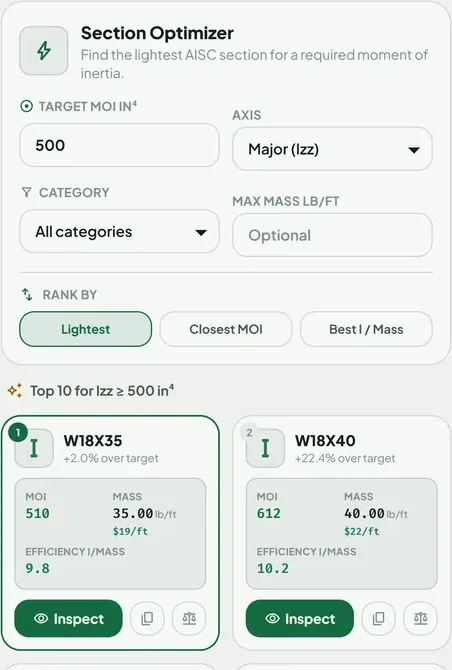
For a heavier load the numbers shift. At 1.55 kip/ft on the same span the required Ix is about 500 in⁴. Steel Table USA's Optimizer for a target of 500 in⁴ returns the W18x35 first (510 in⁴, 35 lb/ft), then the W18x40 and W16x40, then the MC18x42.7 (554 in⁴, 42.7 lb/ft).
Lightest, closest or best stiffness per pound
The lightest shape is not always the best choice. Steel Table USA gives three ways to rank:
- Lightest sorts by weight per foot, the cheapest steel that meets the target.
- Closest MOI sorts by how little the shape overshoots your target, which suits a tight depth or a known stiffness.
- Best I / Mass sorts by stiffness per pound, which picks out the efficient deep sections.
You can limit the search to one category, for example only W-shapes, or set a maximum weight. Choose the axis too: major (strong) or minor (weak).
What to check after you pick
Stiffness is one of several checks. Before you accept the lightest shape from a list:
- Check bending strength and shear against the factored loads. The guide to beam capacity shows the formulas.
- Check that the depth fits the space. A lighter deeper shape may not fit under a ceiling.
- Check lateral bracing. A long unbraced length cuts bending strength.
- Check the connection and the bearing length at supports.
- Compare cost, not just weight. A shape that is common at your supplier may be cheaper than a slightly lighter one that is rare.
To go from a span and a load to a ranked beam size with strength and deflection checked together, see What size steel beam do I need for a span?
Let the optimizer do the ranking
Open the Optimizer tab in Steel Table USA, type the required I in in⁴, pick the axis, and optionally a category and a maximum weight. The app lists the top ten, with how far each is over the target, mass, cost per foot, and a button to Inspect or add the shape to Compare. You can put up to four shapes in the compare tray and look at dimensions, weight, cost and properties side by side.
Questions people ask
How do I find the required moment of inertia for a beam?
Use Irequired = 5wL⁴ / (384 E δlimit) for a simply supported beam under uniform load, with E = 29,000 ksi and the deflection limit set by your code, often L/360 for floor live load.
What is a typical deflection limit for steel beams?
Floor beams are often limited to L/360 under live load. Other members use different limits, such as L/240 or L/180, depending on the code and what the beam supports. Check the limit for your project.
Is the lightest beam always the cheapest?
Not always. Weight drives the material cost, but availability, fabrication and connection cost matter too. A common shape that is slightly heavier can cost less than a rare one.
Should I use Ix or Sx to check deflection?
Use Ix, the moment of inertia. Sx is the elastic section modulus and is used for stress.
Does a lighter shape always have a smaller moment of inertia?
No. A deeper but lighter shape such as a W18x35 can have more Ix than a heavier shallow shape such as a W12x40. Depth is cubed in the formula.
Can the app rank minor-axis stiffness?
Yes. The Optimizer lets you choose major (Izz) or minor (Iyy) axis before it ranks.
Keep reading
Rank shapes by stiffness and weight
The Section Optimizer in Steel Table USA lists the top ten shapes for your required moment of inertia. Free on Google Play.

For reference, not for sign-off. Shape and bolt values quoted here are as shown in Steel Table USA, which takes rolled shape data from the AISC Shapes Database v16.0 and bolt tables from the RCSC Specification (2020), and the worked examples follow AISC 360 methods under the simplifying assumptions stated in the text. Transcription can contain errors. Check critical values against the AISC Steel Construction Manual and the RCSC Specification, and have designs checked by a licensed engineer. The AISC Specification, Manual and Shapes Database are published by the American Institute of Steel Construction, and the RCSC Specification by the Research Council on Structural Connections. Steel Table USA is an independent app and is not affiliated with or endorsed by either organization.