A 3/4 in structural bolt takes a 13/16 in standard hole. Its minimum pretension is 28 kips in Group 120 (A325 type) and 35 kips in Groups 144 and 150 (A490 type). Turn-of-nut tightening is 1/3 turn for a bolt length up to 4 diameters. A slip-critical joint with Class A surfaces resists 9.5 kips per bolt per slip plane at 28 kips of pretension.
Hole sizes
Bolt holes are bigger than the bolt so that steel can be erected without forcing it. The standard hole is the default. Oversized and slotted holes give more tolerance but cost strength in a bearing connection and need washers. Dimensions are in inches.
| Bolt diameter | Standard | Oversized | Short slot | Long slot |
|---|---|---|---|---|
| 1/2 in | 9/16 | 5/8 | 9/16 × 11/16 | 9/16 × 1-1/4 |
| 5/8 in | 11/16 | 13/16 | 11/16 × 7/8 | 11/16 × 1-9/16 |
| 3/4 in | 13/16 | 15/16 | 13/16 × 1 | 13/16 × 1-7/8 |
| 7/8 in | 15/16 | 1-1/16 | 15/16 × 1-1/8 | 15/16 × 2-3/16 |
| 1 in | 1-1/8 | 1-1/4 | 1-1/8 × 1-5/16 | 1-1/8 × 2-1/2 |
| 1-1/8 in | 1-1/4 | 1-7/16 | 1-1/4 × 1-1/2 | 1-1/4 × 2-13/16 |
| 1-1/4 in | 1-3/8 | 1-9/16 | 1-3/8 × 1-5/8 | 1-3/8 × 3-1/8 |
| 1-3/8 in | 1-1/2 | 1-11/16 | 1-1/2 × 1-3/4 | 1-1/2 × 3-7/16 |
| 1-1/2 in | 1-5/8 | 1-13/16 | 1-5/8 × 1-7/8 | 1-5/8 × 3-3/4 |
For bolts 1-1/8 in and larger, the table follows formulas: the standard hole is the bolt diameter plus 1/8 in, the oversized hole is plus 5/16 in, the short slot is (d + 1/8) × (d + 3/8), and the long slot is (d + 1/8) × 2.5d. Older editions of the specifications used smaller standard holes for 1 in and larger bolts, so check the edition your drawings call for. Which hole type may be used where, and with what washer, is set by the RCSC Specification and your engineer.
Minimum bolt pretension
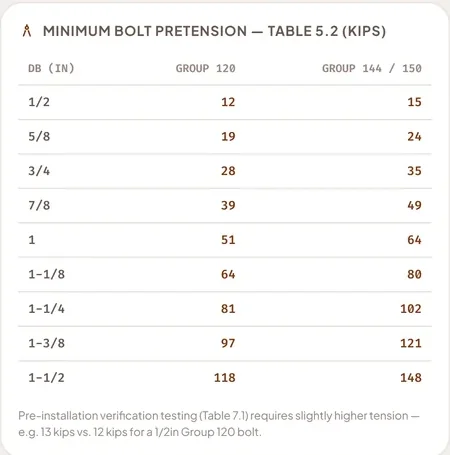
A pretensioned bolt is tightened until it holds a minimum tension. That clamping force is what keeps a slip-critical joint from moving, and it keeps nuts from loosening in a pretensioned bearing joint. The minimum values are in RCSC Table 5.2, in kips:
| Bolt diameter | Group 120 (A325 type) | Group 144 / 150 |
|---|---|---|
| 1/2 in | 12 | 15 |
| 5/8 in | 19 | 24 |
| 3/4 in | 28 | 35 |
| 7/8 in | 39 | 49 |
| 1 in | 51 | 64 |
| 1-1/8 in | 64 | 80 |
| 1-1/4 in | 81 | 102 |
| 1-3/8 in | 97 | 121 |
| 1-1/2 in | 118 | 148 |
The group follows the bolt: Group 120 is the A325 family, and Groups 144 and 150 are the higher-strength bolts, which include A490. Pre-installation verification testing needs slightly higher tension than the table. For a 1/2 in Group 120 bolt, for example, the verification value is 13 kips against 12 kips in the table.
Turn-of-nut rotation
One way to reach the pretension is the turn-of-nut method. After the bolt is snug tight, the nut is turned a set amount that depends on the bolt length, measured from the underside of the head to the end of the bolt. For joints where the faces under the head and nut are normal to the bolt axis:
| Bolt length | Nut rotation |
|---|---|
| Up to and including 4 diameters | 1/3 turn |
| More than 4 and up to 8 diameters | 1/2 turn |
| More than 8 and up to 12 diameters | 2/3 turn |
Other methods exist, including calibrated wrench, twist-off bolts and direct tension indicators. The RCSC Specification describes each and the verification each requires.
Slip resistance
In a slip-critical joint, the strength before slip is friction on the faying surfaces. The AISC 360 formula for each bolt is:
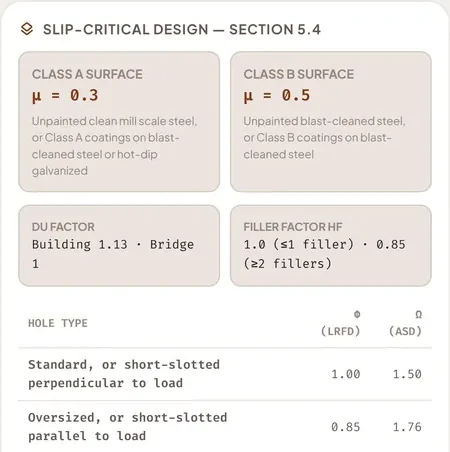
Rn = μ × Du × hf × Tb × ns- μ is the slip coefficient: 0.30 for Class A surfaces (unpainted clean mill scale, or Class A coatings on blast-cleaned steel) and 0.50 for Class B (unpainted blast-cleaned steel, or Class B coatings).
- Du is 1.13 for buildings, a multiplier on the ratio of mean installed pretension to the specified minimum.
- hf is 1.0 with one filler or none, and 0.85 with two or more fillers.
- Tb is the minimum pretension from the table above.
- ns is the number of slip planes.
- φ = 1.00 for standard holes and short slots perpendicular to the load. It is 0.85 for oversized holes and short slots parallel to the load, and lower again for long slots. The app lists the factor for each hole type.
With those factors, the slip resistance of one bolt in one slip plane, with standard holes and no more than one filler, is:
| Bolt diameter | Group 120, Class A | Group 120, Class B | Group 144/150, Class A | Group 144/150, Class B |
|---|---|---|---|---|
| 1/2 in | 4.1 | 6.8 | 5.1 | 8.5 |
| 5/8 in | 6.4 | 10.7 | 8.1 | 13.6 |
| 3/4 in | 9.5 | 15.8 | 11.9 | 19.8 |
| 7/8 in | 13.2 | 22.0 | 16.6 | 27.7 |
| 1 in | 17.3 | 28.8 | 21.7 | 36.2 |
| 1-1/8 in | 21.7 | 36.2 | 27.1 | 45.2 |
| 1-1/4 in | 27.5 | 45.8 | 34.6 | 57.6 |
| 1-3/8 in | 32.9 | 54.8 | 41.0 | 68.4 |
| 1-1/2 in | 40.0 | 66.7 | 50.2 | 83.6 |
A 3/4 in Group 120 bolt gives 0.30 × 1.13 × 28 = 9.49 kips on Class A and 0.50 × 1.13 × 28 = 15.82 kips on Class B. Two slip planes double it.
Worked example
A splice has eight 3/4 in A325 bolts through standard holes with Class B surfaces and two slip planes (a double-lap splice).
- Per bolt per plane: 0.50 × 1.13 × 28 = 15.82 kips.
- Per bolt, two planes: 2 × 15.82 = 31.64 kips.
- Eight bolts: 253.1 kips available before slip.
That slip resistance is below the bearing-type shear strength of the same bolts, which is why a slip-critical joint is a serviceability requirement as well as a strength one. The bolt group capacity guide works the bearing-type numbers.
Which group is my bolt?
Look at the head marking and the specification on the drawings. ASTM F3125 Grade A325 bolts are Group 120. Grade A490 bolts and twist-off bolts of the same strength are Group 150. Group 144 is the 144 ksi class, covered by ASTM F3148. If the drawing and the delivered bolts do not match, stop and ask the engineer, because the pretension values depend on it.
The same tables in Bolt Mode
Flip the switch at the top of Steel Table USA to Bolt Mode. The RCSC tables for hole sizes, minimum pretension, turn-of-nut and slip-critical factors are there, already organized and labeled by table number, so you can find a number with gloves on. On site, you need a pretension for a 3/4 in bolt: the table gives 28 kips in Group 120 and 35 kips in Group 144 and 150. The bolt group calculator in the same mode checks shear, tension and slip-critical capacity. Dark mode and large text help in poor light.
Questions people ask
What size hole do I drill for a 3/4 inch structural bolt?
A standard hole is 13/16 in. An oversized hole is 15/16 in, a short slot is 13/16 by 1 in and a long slot is 13/16 by 1-7/8 in.
What is the minimum pretension of a 3/4 inch A325 bolt?
28 kips for Group 120, from RCSC Table 5.2. Groups 144 and 150 need 35 kips.
What is the turn-of-nut method?
After snug-tightening, the nut is turned a set fraction, 1/3, 1/2 or 2/3 turn depending on bolt length, to reach the minimum pretension.
What is the difference between Class A and Class B surfaces?
Class A (μ = 0.30) covers unpainted clean mill scale and Class A coatings. Class B (μ = 0.50) covers blast-cleaned surfaces and Class B coatings. Class B resists more slip.
What is a slip-critical connection?
A bolted joint designed so that the plates do not slip under service load. It relies on friction from the bolt pretension rather than the bolts bearing on the holes.
What does Group 120 mean?
It is the RCSC group for bolts with a 120 ksi minimum tensile strength, which includes ASTM A325. Groups 144 and 150 are higher-strength bolts, including A490.
Keep reading
Bolt tables on your phone
Steel Table USA Bolt Mode holds the RCSC tables, offline. Free on Google Play.

For reference, not for sign-off. Shape and bolt values quoted here are as shown in Steel Table USA, which takes rolled shape data from the AISC Shapes Database v16.0 and bolt tables from the RCSC Specification (2020), and the worked examples follow AISC 360 methods under the simplifying assumptions stated in the text. Transcription can contain errors. Check critical values against the AISC Steel Construction Manual and the RCSC Specification, and have designs checked by a licensed engineer. The AISC Specification, Manual and Shapes Database are published by the American Institute of Steel Construction, and the RCSC Specification by the Research Council on Structural Connections. Steel Table USA is an independent app and is not affiliated with or endorsed by either organization.