Three layers. ASTM specifications define the steel itself, such as A992 for W-shapes (Fy 50 ksi, Fu 65 ksi), A36 for plate and angles (36 and 58 ksi) and A500 for HSS. AISC 360 is the design specification that turns those values into member strengths. The RCSC Specification governs bolted joints, with bolts made to ASTM F3125. Welding is under AWS D1.1.
How the standards fit together
Structural steel in the United States is governed by a stack of documents that each answer a different question:
- What is the steel? ASTM material specifications, such as A992 and A500. They set chemistry, strength and tolerances.
- How strong is the member? The AISC Specification for Structural Steel Buildings, ANSI/AISC 360. It gives the formulas for bending, shear, tension, compression and connections.
- What are the dimensions and properties of each shape? The AISC Shapes Database and the AISC Steel Construction Manual.
- How are bolts specified and installed? The RCSC Specification for Structural Joints Using High-Strength Bolts, with the bolts themselves made to ASTM F3125.
- How is it welded? AWS D1.1, the Structural Welding Code for Steel.
- Which of these apply to my project? The building code, usually the International Building Code, which adopts AISC 360 and sets load requirements through ASCE 7.
ASTM material specifications and their values
The yield stress Fy and tensile strength Fu in these specifications feed directly into AISC 360 formulas. The values are minimums.
| Specification | Typical use | Fy (ksi) | Fu (ksi) |
|---|---|---|---|
| ASTM A992 | W-shapes, the standard | 50 | 65 |
| ASTM A36 | Plates, angles, channels, bars | 36 | 58 |
| ASTM A572 Grade 50 | Plates and shapes | 50 | 65 |
| ASTM A913 Grade 50 | Quenched and self-tempered shapes | 50 | 65 |
| ASTM A913 Grade 65 | Quenched and self-tempered shapes | 65 | 80 |
| ASTM A588 | Weathering steel | 50 | 70 |
| ASTM A500 Grade B | HSS, rectangular (round is 42) | 46 | 58 |
| ASTM A500 Grade C | HSS, rectangular (round is 46) | 50 | 62 |
| ASTM A53 Grade B | Pipe | 35 | 60 |
| ASTM A615 Grade 60 | Reinforcing bar | 60 | 90 |
The yield stress of some specifications steps down for thicker material, and A992 also has a maximum yield stress. These are the usual values for the common thickness range. Check the specification for your product.
Which specification goes with which shape
The AISC Manual lists the preferred ASTM specification for each shape family. In short:
| Shape | Preferred specification |
|---|---|
| W-shapes | ASTM A992 |
| M and S shapes | ASTM A36 |
| HP shapes | See the Manual table; ASTM A572 Grade 50 is common |
| C and MC channels | ASTM A36 |
| Angles (L) | ASTM A36 |
| Structural tees (WT, ST, MT) | Same as the shape they are cut from |
| HSS, rectangular and round | ASTM A500 Grade C |
| Pipe | ASTM A53 Grade B |
| Plates and bars | ASTM A36 or A572 Grade 50 |
Steel Table USA lets you choose the grade when you inspect a shape, for example A36 or A992, so you can see how the design strength changes with Fy. Always check that the grade you select is one the shape is actually produced in.
AISC 360 and the Manual
AISC 360 is the design specification. It is organized in chapters by topic: general requirements, stability, tension (chapter D), compression (E), flexure (F), shear (G), combined forces (H) and connections (J). The AISC Steel Construction Manual republishes the specification and adds the shape tables and design aids. The 16th edition of the Manual contains AISC 360-16, and the Shapes Database v16.0 is consistent with that edition.
A newer edition, AISC 360-22, exists. Which edition applies to your project depends on the building code your jurisdiction has adopted, so check before you design.
The main design philosophies in AISC 360 are LRFD and ASD. LRFD multiplies loads by load factors and strengths by resistance factors φ. ASD uses service loads and divides strengths by safety factors Ω. Both are valid, and the beam capacity guide works an LRFD example.
Bolts and the RCSC Specification
High-strength structural bolts are made to ASTM F3125. Two grades are well known: A325 (120 ksi minimum tensile strength, called Group 120 by RCSC) and A490 (150 ksi, Group 150). Twist-off bolts, which are tightened until a splined end shears off, belong to the same groups. ASTM A307 bolts are lower-strength carbon steel bolts for general use, with a minimum tensile strength of 60 ksi. They are not used where pretension is required.
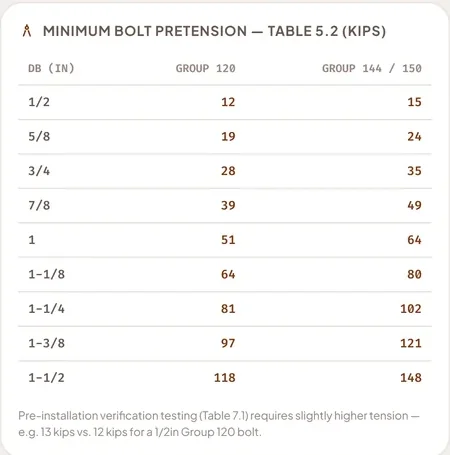
The RCSC Specification covers the installation side: hole sizes, minimum bolt pretension, tightening methods such as turn-of-nut, and slip-critical surface classes. Steel Table USA's Bolt Mode follows the 2020 RCSC Specification and labels each table by number. Two guides use those tables: the hole size and pretension chart and the bolt group capacity guide.
Welding and other documents
- AWS D1.1 covers welding procedures, qualification and inspection for structural steel.
- AISC 303, the Code of Standard Practice for Steel Buildings and Bridges, sets the contract practices between owner, engineer, fabricator and erector.
- AISC 341, the Seismic Provisions, applies to systems designed for seismic forces.
- ASCE 7 sets the design loads and load combinations used with AISC 360.
How the app uses them
Rolled shapes in Steel Table USA come from the AISC Shapes Database, version 16.0, and both the inch and metric values are AISC's own columns. The Design Capacity card follows AISC 360 for bending, shear and tension and lists its assumptions. Bolt Mode follows the 2020 RCSC Specification. Bars, flats, plate and sheet are computed from your own size at 7850 kg per cubic metre.
The app is a reference. It does not replace the standards, and the standards do not replace an engineer's judgment. Use it to find numbers quickly, then verify the ones that matter against the source documents.
Questions people ask
What yield strength does A992 steel have?
ASTM A992 has a minimum yield stress of 50 ksi and a minimum tensile strength of 65 ksi, and it limits the maximum yield stress and the yield to tensile ratio. It is the standard specification for W-shapes.
What is the difference between A36 and A992?
A36 has a minimum yield stress of 36 ksi and A992 has 50 ksi. A992 is used for W-shapes, while A36 is common for plates, angles, channels and bars.
What does AISC 360 cover?
It is the ANSI/AISC specification for structural steel buildings. It covers design requirements for tension, compression, bending, shear, combined forces, connections, fabrication and quality.
What is the difference between A325 and A490 bolts?
A325 bolts have a 120 ksi minimum tensile strength and A490 bolts have 150 ksi. Both are grades under ASTM F3125 and both are installed under the RCSC Specification.
Which HSS grade should I specify?
AISC practice lists ASTM A500 Grade C as the preferred grade for HSS, round and rectangular. Grade B is also common. Check availability with your supplier.
Does the app replace the AISC Manual?
No. It is a quick reference built on AISC data. For design, use the current Manual and Specification adopted by your jurisdiction and have the work checked by a licensed engineer.
Keep reading
The steel references in your pocket
Steel Table USA puts the AISC shapes database and RCSC bolt tables on your phone, offline. Free on Google Play.

For reference, not for sign-off. Shape and bolt values quoted here are as shown in Steel Table USA, which takes rolled shape data from the AISC Shapes Database v16.0 and bolt tables from the RCSC Specification (2020), and the worked examples follow AISC 360 methods under the simplifying assumptions stated in the text. Transcription can contain errors. Check critical values against the AISC Steel Construction Manual and the RCSC Specification, and have designs checked by a licensed engineer. The AISC Specification, Manual and Shapes Database are published by the American Institute of Steel Construction, and the RCSC Specification by the Research Council on Structural Connections. Steel Table USA is an independent app and is not affiliated with or endorsed by either organization.